Tag Archives: economy

Salaries, pensions and benefits to increase in Uzbekistan: what will change from July 1 and September 1, 2026

The government will increase salaries, pensions, scholarships and social benefits under Presidential Decree No. PF-115, signed on June 23, 2026. Some changes will take effect on July 1, while others will come into force on September 1. Pensions and benefits to rise by 7% from July 1 Starting July 1, 2026, pensions, social benefits, child

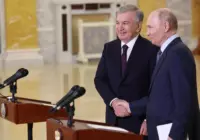
Mirziyoyev in St. Petersburg: a nuclear project, trade and a display of alliance amid war

Uzbek President Shavkat Mirziyoyev arrived in St. Petersburg on June 4 to participate in the St. Petersburg International Economic Forum (SPIEF) and hold talks with Russian President Vladimir Putin. His visit comes at a time when the forum no longer attracts the number of world leaders it did before Russia’s full-scale invasion of Ukraine, while

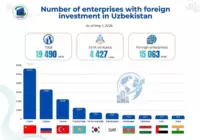
China takes first place: Over 19,000 foreign-capital enterprises now operating in Uzbekistan

The number of foreign-invested enterprises in Uzbekistan continues to grow. According to the National Statistics Committee, as of May 1, 2026, there were 19,490 enterprises with foreign capital operating in the country — 1.4 times more than five years ago. At the same time, the structure of foreign business has changed significantly. Over the past

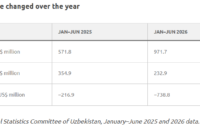
Salaries in Uzbekistan rise 17.4%, but gap between sectors and regions remains stark

The average monthly nominal accrued salary in Uzbekistan reached 6.83 million soums in January–March 2026, up 17.4% compared to the same period last year. The figures were published by the National Statistics Committee in a new press release attached below (in Russian). Salary growth has continued for several consecutive years. According to the agency, the

Uzbekistan and the Czech Republic sign agreements, target $1 billion in trade

Czech Prime Minister Andrej Babiš on Thursday held talks with Uzbekistan’s President Shavkat Mirziyoyev in Tashkent as part of a Central Asia tour, amid Prague’s efforts to expand economic ties beyond the European Union. The sides announced plans to increase bilateral trade to $1 billion and signed a package of agreements covering industry, science, technology,

Central Bank of Uzbekistan strengthens accounting of foreign exchange operations and updates rules for their execution

The Board of the Central Bank of Uzbekistan has adopted a resolution introducing amendments to the rules governing foreign exchange operations. The document is dated March 30, 2026, and was registered with the Ministry of Justice on April 22 under number 3281-5 (attached below in Uzbek). The resolution enters into force on the date of

EU imposes sanctions on two Uzbek companies and activates mechanism against Kyrgyzstan for the first time

The European Union has adopted its 20th package of sanctions against Russia, extending restrictions not only to Russian companies but also to organizations in third countries, including Uzbekistan, and for the first time activating a special anti-circumvention mechanism against Kyrgyzstan. The European Commission announced this on April 23, 2026. EU sanctions two companies from Uzbekistan

Russia and Uzbekistan target $30 billion trade turnover amid progress in nuclear energy

Russia and Uzbekistan intend to increase bilateral trade to $30 billion by 2030, prioritizing projects in nuclear energy and industrial cooperation. Russian Prime Minister Mikhail Mishustin and his Uzbek counterpart Abdulla Aripov met in Moscow on Monday at the sixth meeting of the Joint Commission at the level of heads of government. During the talks,

Mirziyoyev called the EAEU countries “strategic and natural partners” of Uzbekistan

At the meeting of the Supreme Eurasian Economic Council in St. Petersburg on December 21, President of Uzbekistan Shavkat Mirziyoyev called the EAEU countries “strategic and natural partners” of Uzbekistan, and thanked “respected” Vladimir Putin for his hospitality and for organizing the meeting. “In the context of growing fragmentation of global markets, complications in logistics