Despite continuing exports of natural gas, petroleum products and electricity, Uzbekistan is becoming increasingly dependent on imported energy resources. Foreign trade statistics for the first half of 2026 show that the country’s spending on imported gas, oil, gasoline, coal and electricity was nearly three times higher than its export earnings from these resources.
This trend is particularly noticeable against the backdrop of declining domestic production of natural gas, crude oil and gas condensate, as reflected in data from Uzbekistan’s National Statistics Committee.
Fuel imports nearly tripled export revenues
According to foreign trade statistics, Uzbekistan exported mineral fuels, petroleum products, natural gas and electricity worth $772.8 million during January–June 2026.
At the same time, imports of comparable energy products reached $2.23 billion.
As a result, the country recorded a trade deficit in energy resources exceeding $1.45 billion in just six months.
For a country that was long regarded as one of Central Asia’s major natural gas producers, this imbalance is significant.
Gas exports declined sharply
The most notable changes occurred in gas trade.
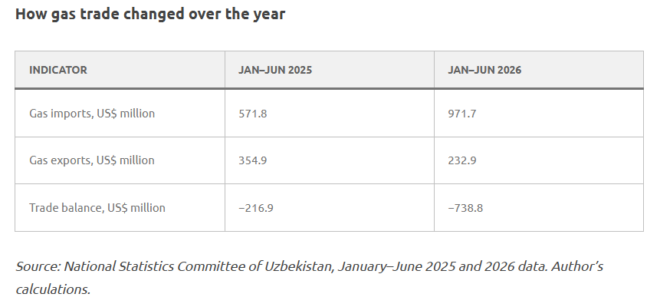
Exports of natural gas (the statistical category includes both natural and manufactured gas) totaled $232.9 million in the first half of 2026, down 34.4 percent from the same period a year earlier.
This was one of the steepest declines among the major energy export categories.
The drop in exports coincided with falling domestic production.
According to the National Statistics Committee, Uzbekistan produced 18.3 billion cubic meters of natural gas in January–June 2026, compared with 21.9 billion cubic meters a year earlier and 22.5 billion cubic meters in the first half of 2024.
Over two years, production declined by nearly 19 percent.
A shrinking resource base inevitably affects the country’s export potential.
Gas imports rose by more than 40 percent
The opposite trend is evident in imports.
Imports of natural and manufactured gas reached $971.7 million in the first half of 2026, an increase of 41.4 percent compared with the same period of 2025. Statistics also separately identify imports of liquefied petroleum gas (propane), which totaled $86.3 million.
In value terms, Uzbekistan imported more than four times as much gas as it exported.
Only a few years ago, such a situation would have seemed unlikely.
For decades, natural gas was one of Uzbekistan’s leading export commodities, and the Soviet-era trunk pipeline network was designed primarily to move Uzbek gas beyond the republic’s borders.
A reversal of gas flows
A symbolic turning point came in October 2023.
That was when Russia began supplying natural gas to Uzbekistan through Kazakhstan via the Central Asia–Center pipeline system.
The project was notable because the pipeline network, which had transported Uzbek gas northward for decades, began operating in reverse for the first time.
During the launch ceremony, Russian President Vladimir Putin recalled that in Soviet times Uzbekistan supplied about 80 billion cubic meters of gas annually through this route to eight Soviet republics.
Several decades later, the flow was reversed.
Agreements signed in 2023 provided for the delivery of up to 2.8 billion cubic meters of Russian gas over a two-year period.
At the time, Uzbek authorities described the project as an important element of energy security and a way to meet growing demand from both the economy and the population.
The latest statistics suggest that dependence on imported gas remains substantial.
Petroleum products become the sector’s leading export category
While gas exports declined, petroleum products drove growth in energy exports.
Exports of petroleum and petroleum products reached $422.2 million in the first half of 2026, up 54.3 percent year-on-year.
By value, this became the largest export category within Uzbekistan’s energy sector.
Petroleum products effectively compensated for a significant share of the losses resulting from lower gas exports.
The increase may be linked to processing imported feedstock and changes in domestic refining patterns, although the statistical report does not explain the reasons.
Gasoline remains a major import item
At the same time, Uzbekistan continues to purchase large volumes of petroleum products from abroad.
Total imports of petroleum and petroleum products reached $1.11 billion.
Gasoline imports increased particularly rapidly.
During January–June 2026, gasoline imports totaled $409.5 million, up 78.5 percent from the previous year.
These import volumes are notable because domestic gasoline production has also been rising.
According to official statistics, Uzbekistan produced 614,200 tonnes of motor gasoline in the first half of 2026, compared with 579,700 tonnes a year earlier.
This suggests that domestic demand is growing faster than local refining capacity can meet it.
Coal remains an important part of the energy mix
Coal imports reached $92.2 million in the first half of the year.
This occurred despite continued domestic coal production.
Moreover, coal output declined again after growth in previous years, falling to 2.5 million tonnes in January–June 2026 from 3 million tonnes a year earlier.
Coal continues to play an important role in supporting industry and electricity generation, particularly when natural gas supplies are constrained.
Uzbekistan remains a net exporter of electricity
Electricity presents a different picture.
Exports of electricity totaled $116.2 million in the first half of 2026, an increase of 13.4 percent compared with the previous year.
Imports were significantly lower at $55.1 million.
As a result, Uzbekistan maintained a positive trade balance in electricity.
This coincided with growth in domestic electricity generation, which reached 44.1 billion kWh during January–June 2026.
The energy sector is undergoing a period of transformation
Changes in foreign trade are occurring alongside major developments within the sector.
In July, President Shavkat Mirziyoyev sharply criticized the management of the energy sector, dismissed the energy minister and replaced the leadership of the country’s largest electricity distribution company.
At nearly the same time, a trial began in Tashkent involving former Uzbekneftegaz chairman Bahodirjon Sidikov and eight other defendants.
Meanwhile, the government announced plans to expand geological exploration, introduce artificial intelligence technologies and modernize the oil and gas industry.
From gas exporter to growing energy importer
Statistics for the first half of 2026 suggest that Uzbekistan’s energy model is gradually changing.
The country continues to export gas, petroleum products and electricity, but dependence on imported fuels is growing much faster.
The shift is especially visible in the gas sector. Only a few years ago, Uzbekistan was focused on exporting more of its own natural gas. Today, the value of gas imports exceeds gas export revenues by more than four times.
Uzbekistan’s energy imports and exports, January–June 2026
| Commodity | Imports, US$ million | Exports, US$ million |
|---|---|---|
| Natural and manufactured gas | 971.7 | 232.9 |
| Petroleum and petroleum products | 1,110.7 | 422.2 |
| Coal, coke and briquettes | 92.2 | 1.5 |
| Electricity | 55.1 | 116.2 |
For now, the government is betting on new exploration projects and modernization of the energy sector. However, the latest figures indicate that the country’s energy security increasingly depends not only on domestic production, but also on the stability of external energy supplies.
Also read:
- Gas output falls, electricity generation rises: what is happening in Uzbekistan’s energy sector?
- Rising demand for aviation fuel and new exploration technologies: what was discussed at the presidential meeting
- Mirziyoyev criticizes energy sector management, dismisses minister and warns industry executives
- Trial begins in Tashkent in case of former Uzbekneftegaz chief: what charges are listed in the court record
- China strengthens its lead as deficit widens: what Uzbekistan’s foreign trade reveals in the first half of 2026
