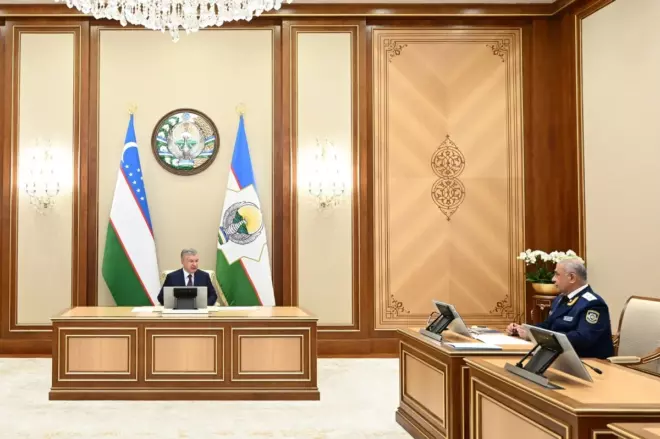
Uzbek President Shavkat Mirziyoyev on June 26 reviewed a presentation on measures to reduce the shadow economy and improve the effectiveness of prosecutorial oversight in this area.
According to data presented at the meeting, the share of the unobserved economy has fallen from 35% to 23% over the past two years. During the same period, an additional 38 trillion soums were recovered for the state budget, the number of officially employed workers exceeded 8.5 million, and the average official monthly salary approached 6.5 million soums.
Despite this decline, the authorities still consider the level of the shadow economy to be high. Statistical estimates show that in the first quarter of 2026, the volume of the unobserved economy amounted to 81.1 trillion soums in agriculture, 24.5 trillion soums in trade and services, 23.9 trillion soums in construction, and 6.7 trillion soums in industry.
The presidential administration noted that the shadow economy reduces budget revenues, creates unequal competitive conditions, contributes to informal employment, and limits access by citizens and businesses to state guarantees and support measures.
By 2030, the government aims to cut the shadow economy in half, increase the number of officially employed people to 14 million, and raise the share of cashless payments to 75%.
The presentation also introduced the “Shadow Economy Map,” a digital platform developed by the Prosecutor General’s Office and launched in pilot mode. The system is designed to identify risks of shadow economic activity, assess potential budget losses, and monitor developments across sectors and regions.
According to the Prosecutor General’s Office, the platform covers 22 key sectors of the economy, 85 areas of activity, 14 regions, and 208 districts and cities. More than 100 risk assessment criteria are used for analysis, while data are received in real time from the information systems of 16 ministries and government agencies.
The system will automatically classify industries and regions into “green,” “yellow,” or “red” categories depending on the level of shadow economy risk. Detected violations include operating without a license, concealing actual turnover, jobs and payroll funds, as well as understating profitability and profit indicators.
Following the presentation, the president instructed officials to integrate more than 70 information systems into the platform by October 1, ensure coverage of all regions and sectors of the economy, and fully launch the system by next year.
The authorities were also tasked with strengthening prosecutorial oversight to create equal competitive conditions for businesses and increase the accountability of officials responsible for reducing the scale of the shadow economy.
Also read:
