Uzbekistan’s authorities have begun preparing a large-scale pension reform that could reshape not only how future pensions are built for millions of citizens, but also the structure of the country’s financial market.
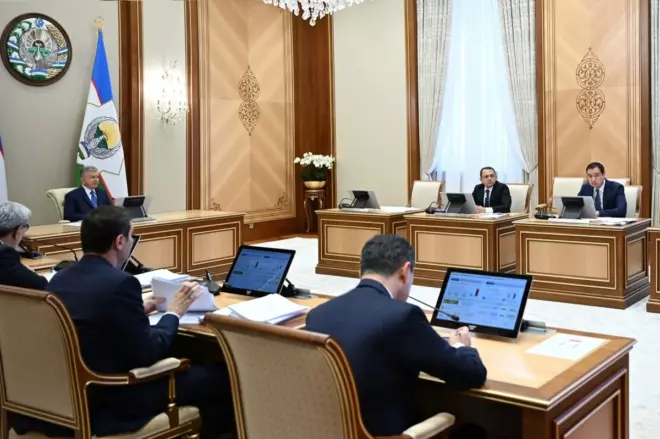
During a presentation to President Shavkat Mirziyoyev on July 14, officials discussed far more than another increase in pension payments or a technical adjustment of calculation formulas. According to the published materials, the government is considering a transition toward a model in which citizens take a more active role in saving for retirement, the state encourages those savings through financial incentives, and accumulated pension assets become a source of long-term investment for the economy.
If implemented, the proposals could lead to one of the most significant pension reforms in Uzbekistan in recent years.
From a state pension system to a mixed model
The most important element of the proposed reform is the instruction to draft legislation establishing private and corporate pension systems.
Today, Uzbekistan’s pension system remains predominantly state-run. Future retirees depend primarily on benefits financed through the existing social security mechanism.
The government now proposes adding elements long used in developed economies: private pension plans and corporate pension schemes established by employers for their employees.
Such an approach would diversify sources of retirement income and reduce pressure on the state budget over the long term. At the same time, it would require a sophisticated regulatory framework, protection for contributors, and effective oversight of pension assets.
Notably, the official statement specifically mentions the International Monetary Fund, the World Bank, the Asian Development Bank, and the International Labour Organization, whose experts, according to the authorities, support the need for reform.
The state is ready to contribute to citizens’ retirement savings
Another major innovation could be a mechanism for state co-financing of pension savings.
Under the proposals, employees earning up to 7.6 million soums (about $630) per month would be able to voluntarily contribute 5 percent of their income to a funded pension account. In return, the government would add an amount equivalent to an additional 2.5 percent of their salary.
In practice, this would amount to direct financial support for citizens willing to participate in the funded pension system.
In many countries, state matching contributions are considered one of the most effective ways to encourage participation in long-term retirement savings programs. For citizens, this means the possibility of building retirement savings more quickly. For the government, it creates incentives for developing a domestic market for long-term capital.
Questions remain, however, about how such contributions would be financed and how extensive the program would become.
Pension savings as a resource for economic development
The reform discussion also reflects another objective: finding new sources of financing for economic growth.
The official statement emphasizes that in countries with developed funded pension systems, pension assets become a source of long-term investment capital.
This is particularly relevant for Uzbekistan. The country’s economy requires substantial investment in infrastructure, industry, energy, and housing construction, while access to long-term domestic financial resources remains limited.
Large-scale pension savings could help change that situation.
In many countries, pension funds are among the largest institutional investors, financing government bonds, infrastructure projects, and capital market development. As a result, the discussion is not only about the future income of retirees but also about creating new mechanisms for economic growth.
Why the government is dissatisfied with the current system
The need for reform is also linked to the limited attractiveness of the existing funded pension model.
Currently, only 0.1 percent of an employee’s salary is transferred to a funded pension account. The annual return on these funds is approximately 10 percent.
According to the government, this is nearly half the return available on bank deposits.
As a result, many citizens do not view pension savings accounts as a meaningful instrument for long-term wealth accumulation.
The proposed reforms are intended to make the system more attractive and encourage greater public participation. However, their ultimate success will depend on whether pension returns can compete with bank deposits and inflation.
Pension calculation rules could change
The authorities are also proposing changes to the way future pensions are calculated.
At present, pensions are calculated based on earnings from any five years of employment during the previous ten-year period. In addition, income above 6 million soums is excluded from the calculation.
According to the reform’s architects, this method does not always reflect citizens’ actual earning histories and can in some cases reduce pension amounts.
The new approach would increase the earnings period used in pension calculations from five years to twenty years. It would also allow certain low-income periods to be excluded from the calculation.
In theory, this should make pension calculations fairer and more closely aligned with a person’s actual employment history.
However, many details remain unclear. Those details will ultimately determine which groups benefit from the reform and which may face less favorable outcomes.
Pension increases are promised, but modestly
Beginning in 2027, the government also proposes raising the maximum salary considered in pension calculations from 6 million to 6.6 million soums.
According to official estimates, the combined effect of the proposed changes could increase pensions for newly retired citizens by approximately 8 percent.
While positive, the increase can hardly be described as transformative. The rise in the salary ceiling amounts to only about 10 percent, roughly comparable to a standard indexation adjustment rather than a dramatic expansion of benefits.
As a result, the reform’s primary impact is likely to come not from changes to the calculation formula itself but from the creation of a new funded pension system.
Authorities seek to avoid public resistance
The political dimension of the reform is also noteworthy.
President Mirziyoyev instructed officials to organize an open discussion of the proposals involving citizens, the media, civil society representatives, and bloggers.
Such an approach is unusual for pension reform, which is often among the most politically sensitive areas of social policy and frequently generates public opposition.
The government therefore appears to be seeking to explain the objectives of the reform and prepare public opinion before submitting legislation to parliament.
The question left outside the presentation: retirement age
Although the presidential press service made no mention of retirement age, discussions about pension reform in Uzbekistan have for years been accompanied by proposals to raise the retirement age.
Representatives of the Pension Fund and international experts have previously argued that the issue deserves consideration in light of increasing life expectancy and growing pressure on the pension system.
According to Uzbekistan’s National Statistics Committee, average life expectancy reached 75.4 years in 2025, up from 66.4 years in 1991.
At the same time, authorities have repeatedly stressed that no final decision has been made.
Currently, men in Uzbekistan retire at 60 and women at 55, among the lowest retirement ages in the region. Earlier discussions included a gradual increase to 63 for men and 58 for women.
For that reason, the current presentation may represent only the first stage of a broader reform process. The introduction of funded pensions, private pension funds, and new calculation methods could pave the way for decisions that were considered politically too sensitive only a few years ago.
Presenting the reform, officials noted that pension payments in Uzbekistan have increased 3.3 times over the past decade and that the minimum pension now exceeds the minimum consumer expenditure level. While more than 1.1 million citizens received pensions below 400,000 soums before 2021, the minimum pension cited in the presentation now stands at 878,000 soums, compared with minimum consumer expenditures of 715,000 soums.
The minimum pension figure mentioned by the presidential press service is 878,000 soums ($73). However, under a presidential decree issued on June 23 and effective from July 1, the minimum old-age pension is set at 983,000 soums ($81.5) per month. The 878,000-soum figure applies to certain categories of recipients, including individuals with incomplete employment records.
Meanwhile, complaints about pension calculations are not uncommon in Uzbekistan. Many retirees report difficulties proving their employment histories, obtaining archival records, and ensuring that all periods of work are properly reflected in pension assessments.
Also read:
