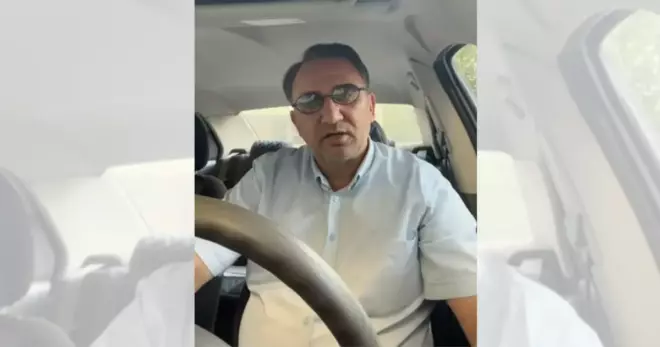
The Shaykhantakhur District Criminal Court of Tashkent has convicted blogger Aziz Hakimov, known online as Comrade Aziz. The court found him guilty of inciting national hatred, defamation and insult, sentencing him to four years and two months of imprisonment.
The information was announced on August 11 by Hakimov’s lawyer, Sergey Mayorov, following the verdict.
According to the lawyer, the court simultaneously acquitted Hakimov on the charge of war propaganda — one of the most serious accusations included in the case since his arrest last autumn.
“Aziz Hakimov was found guilty on three counts: incitement of national hatred, defamation and insult. He was acquitted on the charge of war propaganda,” Mayorov said.
Hakimov has been in custody since September 2025. According to his lawyer, the court credited the time he has already spent in detention, meaning he has approximately three years and three months left to serve.
Settlement colony instead of a regular prison
According to the defense, the court ordered Hakimov to serve his sentence in a settlement colony, the least restrictive form of imprisonment available under Uzbekistan’s penal system.
Once the verdict enters into legal force, penitentiary authorities will determine which specific settlement colony Hakimov will be transferred to. According to Mayorov, the facility will likely be located near Tashkent.
“This is considered imprisonment, but it is to be served in a settlement colony,” the lawyer said.
He added that Hakimov will be allowed to use a basic mobile phone and maintain contact with a limited circle of people. Relatives will also be able to visit him more frequently than inmates held in stricter correctional facilities.
The verdict will not take effect for at least ten days unless it is appealed.
Defense does not plan to appeal
According to Mayorov, Hakimov does not intend to challenge the verdict in the near future.
“He wants the verdict to enter into force as quickly as possible so that he can be transferred to the settlement colony,” the lawyer said.
The decision suggests that Hakimov prefers to leave the pre-trial detention center as soon as possible and move to a facility with less restrictive conditions.
Mayorov also said that his client’s health does not currently cause serious concern.
Possibility of parole
According to the lawyer, Uzbek legislation allows for parole after a certain portion of a sentence has been served.
Mayorov said that, taking into account the time Hakimov has already spent in detention, he may soon become eligible for early release on parole.
“If no disciplinary violations are recorded against him and he behaves properly, he will become eligible for parole within a few months,” Mayorov said.
Why the trial was closed
One of the most notable aspects of the case was that the proceedings were held behind closed doors.
Since the start of the hearings, journalists were not allowed into the courtroom, and participants were required to sign non-disclosure commitments regarding the details of the trial.
After the verdict, Mayorov publicly commented on the possible reasons for the closed proceedings.
According to him, some of the victims in the case were well-known public figures, and the case materials touched on issues related to their private lives and personal connections.
At the time of publication, this explanation had not been independently confirmed by the court.
A case that lasted nearly a year
Aziz Hakimov was arrested in September 2025 after criminal charges were brought against him under four articles of Uzbekistan’s Criminal Code: war propaganda, incitement of national, racial, ethnic or religious hatred, defamation and insult.
From the beginning, the case attracted significant public attention both inside Uzbekistan and abroad.
Hakimov became known through his Telegram channel, Comrade Aziz, and social media accounts, where he regularly expressed support for Russia and Russian government policies, including in the context of the war in Ukraine.
His publications frequently brought him into conflict with Uzbek journalists, bloggers, human rights activists and public figures.
Among the victims listed in the case were blogger Nikita Makarenko, former lawmaker Rasul Kusherbayev, Journalism University rector Sherzodkhon Kudratkhoja, as well as Nozima Muratova, Shakhnoza Ergashova and Madina Amreyeva.
The proceedings took several turns
The case was marked by lengthy procedural disputes.
In the spring of 2026, the defense succeeded in having the case returned to prosecutors for the correction of procedural deficiencies. At the time, Mayorov argued that certain documents had been added to the case file after the defense had already completed its review of the materials.
The court granted the defense motion and returned the case to prosecutors.
The trial on the merits began on July 3.
All hearings were conducted behind closed doors. As a result, witness testimony, arguments presented by the parties and the evidence examined by the court never became public.
Throughout the proceedings, Hakimov’s supporters regularly gathered outside the courthouse. During some hearings, their numbers reached several dozen people.
International attention
The case attracted interest beyond Uzbekistan.
Before the trial on the merits began, Russian Foreign Ministry spokeswoman Maria Zakharova publicly commented on the proceedings.
She said Moscow was monitoring developments surrounding the blogger, described him as a “long-standing and reliable friend” of Russia, and expressed hope for a fair and humane court decision.
The case was later discussed at a roundtable in Moscow organized by the Russian media outlet Ridus.
Participants viewed the matter not only as a criminal case against a blogger but also as part of a broader debate about Russian influence in Central Asia, the region’s relations with Moscow, and competing political views regarding the war in Ukraine.
During the Moscow discussion, Mayorov argued that the conflict surrounding Hakimov stemmed from a long-running dispute between his client and Tashkent-based blogger Nikita Makarenko.
Acquittal on the war propaganda charge
The most significant outcome of the trial was the court’s decision not to convict Hakimov on the charge of war propaganda.
From the outset, this charge had been considered one of the most serious accusations against him and carried the prospect of a substantially harsher sentence.
Following Hakimov’s arrest, the defense argued that part of the case was based on publications and images that investigators had classified as war propaganda. Mayorov consistently challenged the expert assessments and maintained that no crime had been committed.
The court ultimately accepted this argument only in part, acquitting Hakimov on the war propaganda charge while convicting him of incitement of national hatred, defamation and insult.
As a result, a nearly eleven-month investigation followed by a closed trial ended with a conviction carrying a custodial sentence. However, the punishment was significantly lighter than the sentence Hakimov could have faced had he been found guilty on all four original charges.
What the court said after the verdict was announced
After this article was published, the press service of the Tashkent courts released an official statement on the case.
According to the court, Aziz Hakimov, born in 1975, was found guilty under Part 2 of Article 156 of Uzbekistan’s Criminal Code (incitement of national, racial, ethnic or religious hatred), Part 2 of Article 139 (defamation), and Part 2 of Article 140 (insult). He was acquitted of the charge under Article 150 of the Criminal Code (war propaganda) due to the absence of a criminal offense.
The court ruled that Hakimov’s sentence should be calculated from September 26, 2025. In addition, the Ministry of Digital Technologies was instructed to ensure the blocking of the Comrade_Aziz Telegram channel operated by Hakimov.
The court also informed the six victims in the case of their right to file civil claims seeking compensation for material and moral damages.
Reaction of a victim
One of the victims in the case, blogger Nikita Makarenko, welcomed the court’s decision.
In a post on his Telegram channel, he noted that he had participated in the proceedings as a victim and stated that for several years Hakimov had spread “false, defamatory and insulting information” about him.
Makarenko also described the verdict as fair and thanked law enforcement authorities and the court for protecting his rights.
In addition, the blogger stated that Hakimov had opposed Uzbekistan’s sovereignty, promoted the idea of restoring the Soviet Union, and made negative statements about the memory of victims of political repression and the national liberation movement. These assessments reflect Makarenko’s opinion and do not appear in the court’s published statement.
Also read:
- Zakharova criticizes Hakimov’s opponent after Tashkent court verdict
- The Aziz Hakimov case: from a Tashkent courtroom to debates about Central Asia in Moscow
- Lawyer comments on Aziz Hakimov’s condition after latest court hearing
- Trial on the merits begins in Tashkent against pro-Russian blogger Aziz Hakimov
- Trial in the case of “Comrade Aziz”: case returned to prosecutor amid pressure on the press
- The trial of blogger Aziz Hakimov begins in Tashkent; defense alleges document forgery
- In Uzbekistan, blogger Aziz Hakimov known for promoting Russian propaganda narrative arrested
