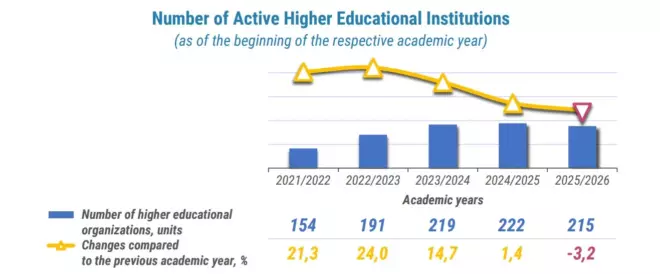
For the first time in recent years, the number of higher education institutions in Uzbekistan has declined. At the beginning of the 2025/2026 academic year, 215 institutions were operating in the country — seven fewer than a year earlier. At the same time, the higher education system continued to grow in terms of student enrollment, admissions, and teaching staff.
Number of higher education institutions in Uzbekistan declines for the first time in recent years
According to data from the National Statistics Committee (attached below), the number of higher education institutions had been increasing steadily for several years, rising from 154 in the 2021/2022 academic year to 222 in 2024/2025. However, in the current academic year, this figure decreased by 3.2%. The number of non-state institutions also fell, from 99 to 97.
Table 1. Higher education in Uzbekistan: key indicators
| Indicator | 2024/2025 | 2025/2026 | Change |
|---|---|---|---|
| Higher education institutions | 222 | 215 | -3.2% |
| Non-state education institutions | 99 | 97 | -2.0% |
| Students | 1.433 million | 1.535 million | +7.1% |
| Newly admitted students | 381.7 thousand | 409.7 thousand | +7.3% |
| Master’s students | 39.8 thousand | 56.3 thousand | +41.5% |
| Academic staff | 49.6 thousand | 54.9 thousand | +10.7% |
More than 1.5 million students enrolled in institutions
Despite the reduction in the number of educational institutions, student enrollment continued to grow. At the beginning of the academic year, 1.535 million people were studying at higher eduction institutions across the country — 102.2 thousand more than a year earlier. Over the past five years, the number of students has nearly doubled, increasing from 808.4 thousand in the 2021/2022 academic year to the current level.
Women make up the majority of students
Admissions also increased. In the 2025/2026 academic year, 409.7 thousand students were admitted to institutions, 7.3% more than in the previous year. More than half of all new students were women, accounting for 55.4% of admissions. Statistics show that since the 2023/2024 academic year, the number of female applicants has consistently exceeded the number of male applicants.
Among graduates, however, the gender balance remains almost equal. In 2025, 112.5 thousand women and 113.4 thousand men received degrees.
Table 2. Gender composition of higher education students in Uzbekistan
| Category | Women | Men |
|---|---|---|
| All students | 782.9 thousand (51.0%) | 752.1 thousand (49.0%) |
| Newly admitted students | 226.8 thousand (55.4%) | 182.9 thousand (44.6%) |
| 2025 graduates | 112.5 thousand (49.8%) | 113.4 thousand (50.2%) |
Master’s admissions increased by more than 70%
The most significant growth was recorded in master’s programs. The number of students admitted to master’s degrees increased by 70.4%, from 21.6 thousand to 36.8 thousand. The total number of master’s students already enrolled at institutions grew by 41.5% over the year, reaching 56.3 thousand.
Nearly half of all students are concentrated in Tashkent
Almost half of all newly admitted master’s students were enrolled in Tashkent. The capital also remains the country’s main higher education center. It is home to 98 higher education institutions, or nearly 46% of all higher education institutions in Uzbekistan, while the number of students exceeds 579 thousand.
Table 3. Regions with the largest number of students
| Region | Number of students | Share of total |
|---|---|---|
| Tashkent | 579.3 thousand | 37.7% |
| Bukhara Region | 117.7 thousand | 7.7% |
| Kashkadarya Region | 111.6 thousand | 7.3% |
| Tashkent Region | 101.5 thousand | 6.6% |
| Fergana Region | 98.9 thousand | 6.4% |
| Samarkand Region | 93.9 thousand | 6.1% |
Number of graduates continues to increase
In total, higher eduction institutions in Uzbekistan graduated 225.9 thousand specialists in 2025, which is 7% more than a year earlier.
Number of academic staff increased to 54.9 thousand
Alongside the growing number of students, the teaching workforce is also expanding. At the beginning of the academic year, higher eduction institutions employed 54.9 thousand faculty and teaching staff members, excluding part-time instructors, which is 10.7% more than the previous year.
Our calculation of the student-to-faculty ratio
However, the teaching load in Uzbekistan remains significantly higher than the average in developed countries. Based on calculations using National Statistics Committee data, there are approximately 28 students per academic staff member.
For comparison, the average ratio across OECD countries is about 15 students per academic staff member in public universities and 18 students per academic staff member in private institutions.
The OECD, or the Organisation for Economic Co-operation and Development, is a forum and knowledge center that provides data, analysis, and information on best practices in public policy.
However, the OECD uses the indicator of academic staff measured in full-time equivalents (FTE), while Uzbek statistics report the number of academic staff excluding part-time instructors. Therefore, the methodologies are not fully comparable.
Conclusions
Despite the continued growth in student enrollment, international practice does not establish an optimal number of students per capita. Instead, assessments typically focus on the quality of education, accessibility of higher education, and the employability of graduates in the labor market. How these indicators compare in Uzbekistan remains an open question. Share your views in the comments.
