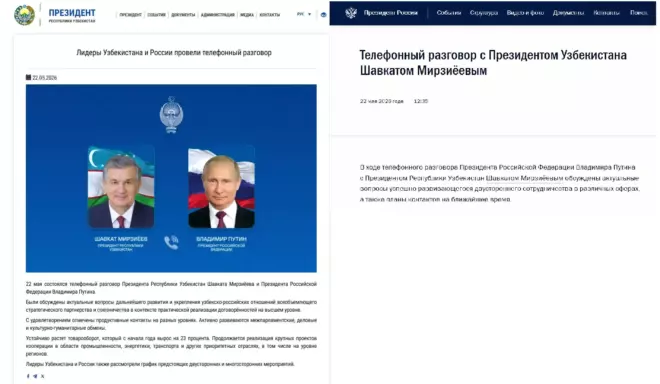
The press services of Shavkat Mirziyoyev and Vladimir Putin released statements about the presidents’ phone conversation on May 22, but their presentation differed noticeably. The Uzbek side provided a detailed description of economic and interregional cooperation, while the Kremlin limited itself to a brief official statement without specific details.
The difference in the coverage of the phone call was noticeable less in substance than in volume and emphasis.
The statement from the Uzbek president’s press service consisted of several paragraphs and contained a detailed description of areas of cooperation. The release separately listed interparliamentary, business, and humanitarian contacts, growth in trade turnover, implementation of projects in industry, energy, and transport, as well as cooperation between regions. In addition, the Uzbek side cited a specific figure: according to its data, trade turnover has increased by 23% since the beginning of the year.
The statement also emphasized the phrase “comprehensive strategic partnership and alliance” and referred to what was described as the “practical implementation of agreements reached at the highest level” (translated from Russian). The text was built around an economic and institutional agenda.
The Kremlin issued a significantly shorter statement. The Russian presidential press service only said that the sides discussed “successful development of bilateral cooperation across various spheres” and “plans for contacts in the near future,” without specifying sectors, figures, or individual areas of interaction.
At the same time, there was virtually no difference in the substance of the statements: both sides spoke about the development of bilateral cooperation and future contacts. However, the Uzbek presidential press service focused on detail and demonstrating economic dynamics, while the Kremlin used a maximally concise and formal format for its statement.
Related articles:
