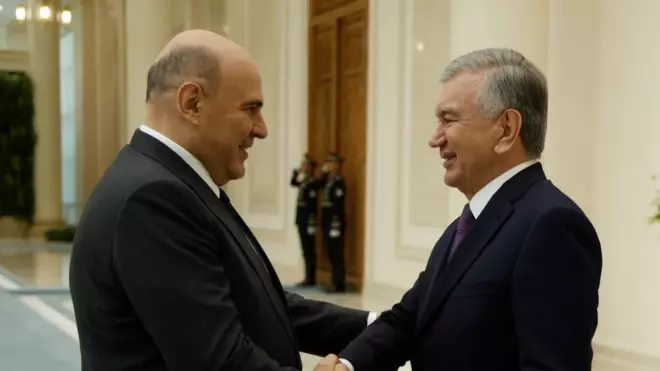
On June 16, Uzbek President Shavkat Mirziyoyev received Russian Prime Minister Mikhail Mishustin, who arrived in Tashkent to participate in the Fifth Tashkent International Investment Forum. During the day, the Russian prime minister also held talks with Uzbek Prime Minister Abdulla Aripov and Head of the Presidential Administration Saida Mirziyoyeva.
According to published transcripts and official statements from both sides, the central topics of the discussions were trade and economic cooperation, investment, construction of Uzbekistan’s first nuclear power plant, transport projects, and humanitarian ties.
Mirziyoyev and Mishustin discussed trade, investment, and regional cooperation
Following the meeting between Mirziyoyev and Mishustin, the Uzbek presidential press service said the parties discussed the implementation of agreements reached at the highest level, as well as the further development of strategic partnership and allied relations between the two countries.
Tashkent noted that bilateral trade had increased by 20 percent since the beginning of the year. Major projects in energy, metallurgy, and other sectors of the economy are also continuing. The Uzbek president advocated expanding cooperation between the regions of the two countries and further developing cultural and educational exchange programs.
The most substantive part of the visit appears to have been Mishustin’s talks with Uzbek officials, the transcripts of which were published by the Russian side.
The nuclear power plant was the central topic of the meeting with Saida Mirziyoyeva
During the meeting with Saida Mirziyoyeva, special attention was paid to humanitarian projects, education, and the construction of a nuclear power plant.
“The NPP project is very important for us; it is the foundation of a new high-tech industry,” Mirziyoyeva said.
According to her, negotiations on the project lasted eight years, while practical preparations for construction were completed within a short period after key decisions had been agreed upon.
She also highlighted the high level of interaction between the government institutions of the two countries and recalled recent Uzbek cultural events in St. Petersburg, including the premiere of the opera Tamerlane at the Mariinsky Theatre and exhibitions at the Hermitage Museum and the Fabergé Museum.
Saida Mirziyoyeva also addressed education. According to her, Uzbekistan hosts the largest number of Russian university branches among foreign countries.
“I think we have room for growth. I would very much like to see private schools open as well. There is very strong demand,” she said, referring to the prospects for opening new educational institutions with Russian participation.
In response, Mishustin emphasized the significance of Mirziyoyev’s speech at the St. Petersburg International Economic Forum 12 days earlier and reaffirmed Moscow’s interest in expanding economic cooperation.
“There is a task for our governments to bring trade turnover to $30 billion,” the Russian prime minister said.
He also described the construction of the nuclear power plant as an important stage in the country’s development.
“A high-tech industry will be created, and qualified specialists in science and technology will emerge,” Mishustin noted.
In addition to nuclear energy, he mentioned cooperation in agriculture, industry, infrastructure, and transportation, including discussions on the Trans-Afghan route and the North–South International Transport Corridor.
Aripov and Mishustin discussed trade, investment, and new projects
The economic agenda was discussed in even greater detail during Mishustin’s talks with Prime Minister Abdulla Aripov.
The head of the Uzbek government said that bilateral trade had more than tripled over the past ten years and exceeded $13 billion. According to him, during the first four months of this year, the figure increased by another 20 percent and surpassed $4.5 billion.
Aripov said the total portfolio of joint projects had reached $47 billion, while $1.5 billion in Russian investments had been utilized since the beginning of the year.
“The main task is to maintain this momentum and fully realize the existing potential,” he said.
Among the promising areas of cooperation, the Uzbek prime minister named digitalization, the creation of a unified digital employment profile, the development of artificial intelligence-based products, and joint platforms for human capital development.
Mishustin, in turn, said Russia remains one of the largest investors in Uzbekistan’s economy and is interested in expanding joint projects.
“We have good opportunities to launch a large number of new joint projects in energy, industry, transport infrastructure, agriculture, and the digital economy,” the Russian prime minister said.
A significant portion of the remarks made by Russian and Uzbek officials focused on the nuclear project. After the presidents of Uzbekistan and Russia launched construction work at the future plant site on June 4, the NPP project has effectively become one of the key symbols of the current stage of bilateral cooperation.
For Russia, the project has not only political but also substantial economic significance. It provides multi-billion-dollar orders for Russian industry, creates a long-term market for fuel supplies and maintenance services, allows Moscow to showcase new nuclear technologies internationally, and strengthens Russia’s position in Central Asia.
In Tashkent, meanwhile, the construction of the plant is described as an important element in meeting the future needs of the country’s rapidly growing economy.
Beyond economics and energy, both sides repeatedly emphasized the importance of humanitarian ties. During the meetings, officials discussed the work of Russian university branches in Uzbekistan, Russian-language education programs, cultural exchanges, and cooperation between regions of the two countries. During his meeting with Saida Mirziyoyeva, Mishustin also thanked her for her attitude toward the Russian language: “I would like to personally thank you for your attitude toward the Russian language.”
Mishustin’s visit to Tashkent came less than two weeks after talks between Mirziyoyev and Russian President Vladimir Putin in St. Petersburg. As a result, the focus of the current meetings was not on developing new political decisions but on discussing the practical implementation of agreements already reached and advancing major joint projects in the fields of economy, energy, transportation, and education.
Also read: