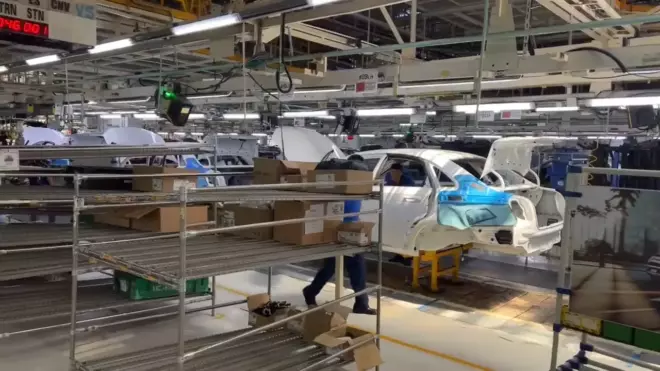
The automotive industry remains one of the most visible pillars of Uzbekistan’s industrial sector, yet statistics for the first half of 2026 reveal an increasingly clear gap between domestic production and demand for transport equipment. While local factories are increasing passenger car output and expanding production of new models, imports of vehicles, components, and other transport equipment are growing much faster. As a result, the country remains a major importer of transport-related products despite the continued expansion of its domestic automotive industry.
Exports of vehicles from Uzbekistan declined despite rising production
According to data from the National Statistics Committee, exports of machinery and transport equipment from Uzbekistan totaled $632.9 million in January–June 2026, an increase of 32.3 percent compared with the same period last year.
At the same time, exports of motor vehicles reached $130.4 million, down 5.4 percent from the first half of 2025. Exports of automotive parts and accessories amounted to $111.8 million, a decline of 4.1 percent.
In contrast, exports of other transport equipment performed more strongly. Their value reached $115 million, up 64.2 percent year-on-year. Even such rapid growth, however, was not enough to change the broader picture: exports of transport-related products remain relatively modest compared with import volumes.
Vehicle imports exceeded $2 billion
The imbalance becomes even more apparent when import data are examined. During the first six months of 2026, Uzbekistan imported $8.25 billion worth of machinery and transport equipment, roughly 25 percent more than a year earlier.
Of that amount, $2 billion was spent on motor vehicles, representing a 31.7 percent increase compared with the first half of 2025. Imports of passenger cars and other vehicles primarily designed for transporting people grew particularly rapidly, reaching $778.3 million, up 84.5 percent year-on-year.
In effect, the growth rate of passenger vehicle imports was several times higher than the growth rate of domestic vehicle production. This may indicate sustained demand for models not manufactured in Uzbekistan, as well as growing consumer interest in imported brands and electric vehicles.
Imports of auto components remain far higher than exports
Automotive parts and components remain another major import category. Between January and June, Uzbekistan imported $904.3 million worth of vehicle parts and accessories.
Despite the existence of domestic component manufacturing, imports exceeded exports of automotive parts by nearly eight times.
Imports of other transport equipment also remained substantial, totaling $378.6 million. Aircraft and other powered fixed-wing aircraft accounted for $202 million of that figure. Although aircraft imports declined by 12.3 percent compared with the previous year, aviation equipment continues to occupy a significant place in the country’s import structure.
Passenger car production increased by 12.8 percent
At first glance, industrial production statistics paint a far more optimistic picture.
In the first half of 2026, Uzbekistan produced 235,794 passenger cars, compared with 208,975 during the same period of 2025, representing growth of approximately 12.8 percent.
Truck production also increased, rising from 2,268 units to 2,751, a gain of about 21 percent.
Chevrolet Cobalt remained the country’s best-selling model
Chevrolet Cobalt continued to be Uzbekistan’s most-produced passenger vehicle. During the first six months of the year, factories assembled 82,951 units, compared with 73,102 a year earlier.
Production increased by more than 13 percent, meaning that the Cobalt accounted for more than one-third of all passenger cars manufactured in the country.
Damas production declined while Kia and Haval expanded
Damas remained the second most-produced model, although its performance moved in the opposite direction. Output fell from 45,992 vehicles to 42,663.
Despite the decline, Damas continues to play an important role for small businesses, delivery services, and local transportation.
Production of the Tracker increased only slightly, from 22,847 to 23,249 units. The Onix recorded stronger growth, with output rising from 17,249 to 18,715 vehicles.
While production of traditional Chevrolet models for the Uzbek market grew only modestly—or in some cases declined—vehicles produced under Kia and Chinese brands showed much stronger momentum.
Kia production increased by nearly 29 percent to 15,184 units. Output of Chery vehicles rose to 4,384, while Haval production reached 5,061, an increase of roughly 43 percent.
BYD became Uzbekistan’s fastest-growing automotive brand
The most impressive growth was recorded by BYD.
During the first half of 2026, production of BYD vehicles climbed to 13,405 units from 7,000 a year earlier. The near doubling of output reflects the rapid expansion of the electric and hybrid vehicle segment in Uzbekistan.
Another noteworthy development was the introduction of the Chevrolet Damas Move. According to official statistics, 132 units were produced in April and 324 in May.
Although production volumes remain small, the launch of the new version suggests that manufacturers are seeking to modernize offerings in one of the country’s most important market segments.
Why rising production has not reduced import dependence
Despite growing production, Uzbekistan’s dependence on imports has not diminished.
Vehicle exports totaled $130.4 million, while vehicle imports reached $2 billion, creating a gap of more than fifteenfold. A similar pattern can be seen in the component sector, where imports exceed exports by nearly eight times.
These figures suggest that rising production alone does not automatically lead to a more balanced trade position. Uzbekistan is manufacturing more vehicles than ever, but at the same time the economy is purchasing even more vehicles and components from abroad.
Several factors may explain this trend, including rising household incomes, expanding corporate vehicle fleets, growing demand for electric vehicles, continued development of transport and logistics infrastructure, and ongoing industrial modernization.
Nevertheless, the statistics for the first half of 2026 point to one central conclusion: domestic demand for transport equipment is growing faster than the capacity of the national automotive industry to satisfy it.
What the data reveal about Uzbekistan’s automotive market in the first half of 2026
The automotive sector remains one of Uzbekistan’s most significant industrial success stories. At the same time, it has become one of the clearest examples of the country’s continuing dependence on imports.
While factories are increasing production of models such as the Cobalt, BYD, and others, trade data show that Uzbekistan still purchases far more transport-related products from abroad than it sells on international markets.
Also read:
- Electric vehicles accounted for more than 70% of passenger car imports into Uzbekistan
- Environmental segregation: Tashkent accelerates city zoning and introduces “car-free days”
- China strengthens its lead as deficit widens: what Uzbekistan’s foreign trade reveals in the first half of 2026
- Vehicle registration certificates in Uzbekistan set to 5-year validity
