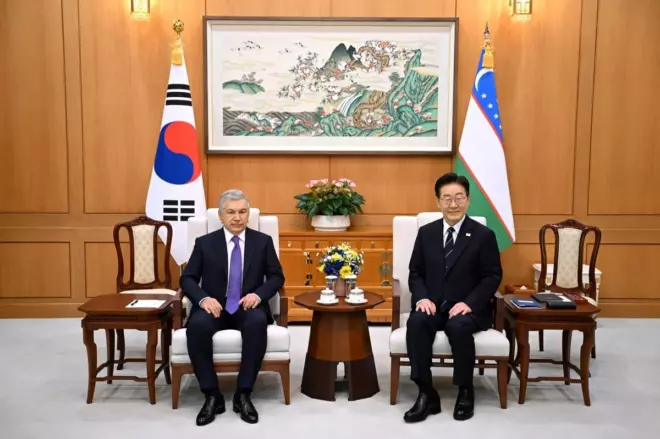
Uzbek President Shavkat Mirziyoyev and South Korean President Lee Jae Myung held talks in Seoul on September 14, after which the two sides exchanged 13 intergovernmental agreements and memorandums of understanding. The Uzbek side also announced the preparation of an investment portfolio worth about $12 billion and an agreement on a strategic partnership with the Korea Eximbank.
The talks took place as part of Mirziyoyev’s state visit to South Korea. According to the Uzbek side, the leaders discussed trade, investment, critical minerals, transport and infrastructure, digital technologies, education, healthcare, and military-technical cooperation.
The South Korean side has so far provided a considerably more limited account of the bilateral talks. According to information released by the Korean side, Lee held talks with Mirziyoyev on September 14 on expanding bilateral cooperation, followed by a ceremony to exchange 13 agreements and memorandums. At the same time, Seoul is viewing Mirziyoyev’s visit primarily in the broader context of the first Korea-Central Asia Summit, which will be held on September 16 with the participation of the leaders of Uzbekistan, Kazakhstan, Kyrgyzstan, Tajikistan, and Turkmenistan.
Lee highlights Tashkent airport and high-speed rail
Following his meeting with Mirziyoyev, South Korean President Lee Jae Myung said the two sides had reaffirmed their intention to deepen their “special strategic partnership” — the only relationship of this level that South Korea has with a Central Asian country.
In a post on X, Lee specifically highlighted the new Tashkent airport and the high-speed railway project, describing them as key areas of cooperation that could become drivers of Uzbekistan’s economic growth.
“Using Korea’s technology and experience, we will open new pathways together — in the sky and on the ground,” Lee wrote.
Lee also said the two sides had agreed to jointly promote a project for a Museum of Korean Diaspora History in Uzbekistan. The project is being pursued ahead of the 90th anniversary of the migration of ethnic Koreans to Central Asia, which will be marked in 2027.
The South Korean president also thanked Uzbekistan for having “warmly embraced and supported” ethnic Koreans during difficult times, describing the Korean community as an important bridge between the two countries.
$12 billion investment portfolio
According to the Uzbek side, the talks identified a number of major areas for economic cooperation. The investment portfolio includes projects with a total value of about $12 billion.
The two sides agreed to adopt a strategic partnership program with Korea Eximbank. The published Uzbek statement does not provide a breakdown of the $12 billion by individual projects.
Mirziyoyev identified five priorities for economic cooperation with South Korea. They include expanding trade, increasing investment, cooperation in critical minerals, and the development of transport and infrastructure.
Another area is to be a technology alliance based on Korean technologies and Uzbekistan’s resource and industrial potential. Its priorities include information technology, cybersecurity, and advanced and digital technologies in medicine, healthcare, and pharmaceuticals.
This agenda overlaps with the priorities Seoul has set for its relations with Central Asia as a whole. According to the South Korean side, one of the goals of the summit is to link the region’s abundant critical-mineral deposits and energy resources with Korean expertise in exploration and processing.
Seoul also hopes to expand opportunities for Korean companies in Central Asian markets, including through cooperation on customs procedures, regulations, intellectual property protection, infrastructure, and plants.
According to a Korea.net article published on September 15, the parties also agreed to establish a Korea Desk within the Government of Uzbekistan to support Korean companies, as well as a joint business council. In the field of critical minerals, cooperation is planned across the entire value chain — from exploration to processing — based on a joint rare metals center. In the area of artificial intelligence, the focus is on digital transformation and the modernization of industry.
13 agreements and memorandums
The package covers a wide range of sectors. According to the Uzbek statement, the agreements cover cooperation in transport and aviation, agriculture, tourism, artificial intelligence, technical assistance, higher, school and preschool education, medical-product regulation, environmental protection and climate change, intellectual property protection, archival affairs, and other areas.
The Korean side also confirms the number of documents — 13 agreements and memorandums — but has not yet published a comparable list of their contents.
More than 700 joint ventures
Uzbekistan regards South Korea as one of its key economic partners. According to Tashkent, more than 700 enterprises with Korean capital operate in the country.
From January through June 2026, the Republic of Korea ranked fourth among Uzbekistan’s largest import suppliers, according to the National Statistics Committee of Uzbekistan, accounting for $906.8 million in imports.
With support from the Korea International Cooperation Agency (KOICA), Korea Eximbank, and the EDCF fund, projects are being implemented in healthcare, industry, information and communications technology, agriculture and water management, energy, infrastructure, and education.
Four branches of South Korean universities and five vocational training centers established with KOICA assistance also operate in Uzbekistan.
During the talks, the two sides agreed to step up contacts not only between the countries’ leaders but also between parliaments, ministries and government agencies, regions, and business communities. An Interregional Forum was held ahead of Mirziyoyev’s visit. The next one is to be held in Samarkand.
Military-technical cooperation
Another area highlighted by Tashkent was military-technical cooperation.
The two sides expressed readiness to expand interagency contacts, organize joint events, and train military personnel.
This area was not mentioned separately in the South Korean side’s published account of the talks with Mirziyoyev.
Education and culture
Education remains another major part of the bilateral agenda. In addition to the four branches of South Korean universities and five vocational training centers, the two sides highlighted the University Presidents’ Forum as a mechanism for exchanging experience in personnel training.
In the humanitarian sphere, Uzbekistan and South Korea agreed to declare 2027 the Year of Culture and Mutual Exchanges.
Mirziyoyev separately highlighted the role of the Korean diaspora in Uzbekistan, describing it as a “spiritual bridge” between the two countries.
Seoul looks to Central Asia
The bilateral meeting between Mirziyoyev and Lee took place ahead of the first Korea-Central Asia Summit, scheduled for September 16.
For South Korea, this will be its first summit with the five Central Asian states. Seoul intends to elevate the Korea-Central Asia Cooperation Forum, which has operated at the ministerial level since 2007, to the summit level and establish a long-term framework for cooperation through the Seoul Declaration.
From September 14 to 16, Lee Jae Myung is holding bilateral meetings with the leaders of all five Central Asian countries. Mirziyoyev and the presidents of Kazakhstan and Turkmenistan are making state visits, while the presidents of Tajikistan and Kyrgyzstan are on official visits.
Following the summit, the leaders of the five Central Asian countries and the South Korean president will take part in a business summit. According to Seoul, around 500 government and business representatives from each side are expected to participate.
Thus, the specific economic agreements between Tashkent and Seoul form part of South Korea’s broader Central Asia initiative. So far, the Uzbek side has disclosed significantly more details of the bilateral talks, including the size of the proposed investment portfolio, areas of cooperation, and details of individual initiatives. The South Korean side’s published account has focused primarily on the upcoming Central Asia summit and has so far provided only a brief account of the Lee-Mirziyoyev meeting and the exchange of 13 documents.
Read also:
