President Shavkat Mirziyoyev will visit Kazakhstan on May 15 at the invitation of President Kassym-Jomart Tokayev. An informal summit of the Organization of Turkic States will be held in the city of Turkistan under the theme “Artificial Intelligence and Digital Development.”
Officially, the agenda includes trade, investment, transport, ecology, digital infrastructure, innovation, and artificial intelligence. The summit is expected to adopt the Turkistan Declaration.
However, the real significance of such summits goes far beyond technical cooperation.
In recent years, the Organization of Turkic States has gradually evolved from a platform of cultural diplomacy into one of the instruments of Central Asia’s geopolitical reorientation. This is not a sudden geopolitical shift, but rather a gradual erosion of Russia’s former cultural monopoly in the region.
Today, Central Asia increasingly appears not as a space with a single external orientation, but as a region with diverging cultural and political vectors.
State elites in the region maintain close pragmatic ties with Russia due to economic, security, migration, and historical factors. At the same time, they are actively pursuing multi-vector foreign policies in an effort to reduce dependence on any single power center.
The Russian-speaking population — regardless of ethnicity — remains closely connected to the Russian information and cultural space. This is especially true for older generations and urban professionals shaped during the Soviet period.
However, among speakers of national languages — now the growing majority — a different trend is emerging. In Uzbekistan, Kazakhstan, and Kyrgyzstan, interest in Turkey and the broader Turkic world is increasing. Turkish TV series, business models, educational programs, and cultural products have become part of everyday life.
At the same time, this shift toward Turkic identity does not represent a uniform cultural realignment exclusively toward Turkey. Part of society is oriented toward the Arab world through religious identity, while another part looks to the West through education, careers, and technology.
For some young people, sympathy toward Turkey or Western countries also reflects a quiet form of disagreement with Russia’s current regional policies. It represents a search for an alternative identity — modern, yet still connected to national and Turkic roots.
Against this backdrop, the Organization of Turkic States serves as a convenient platform for shaping a new shared symbolic space — without a direct break from Russia, but also without the previous level of dependence on it.
At the same time, another process is unfolding in the region that will inevitably be present in the background of the Turkistan summit, even if discussed cautiously in public.
This is the growing influence of China.
Unlike Russia or Turkey, China does not actively compete for cultural influence. Its strategy is far more pragmatic. Beijing does not seek to win “hearts and minds” through language, cinema, or shared historical narratives. Instead, it focuses on infrastructure, energy, industry, and the technology sector.
This has become particularly visible in Uzbekistan, where Chinese automobile brands have rapidly captured a significant share of the market. At the same time, Chinese technologies are expanding in digital infrastructure and “Safe City” surveillance systems.
If Russia has long been the region’s cultural habit, and Turkey a cultural choice, China is increasingly becoming an economic and technological inevitability.
That is why the theme of artificial intelligence and digital development at the Organization of Turkic States summit is not accidental. It is not only about technology, but also about a deeper question: who will control the infrastructure of Central Asia’s future — data, platforms, digital services, and technological standards.
For now, the countries of the region are balancing between multiple centers of power — Russia, Turkey, China, the West, and the Arab world. But the very fact that such discussions are now taking place under the umbrella of Turkic integration shows how rapidly the structure of influence in Central Asia is changing.
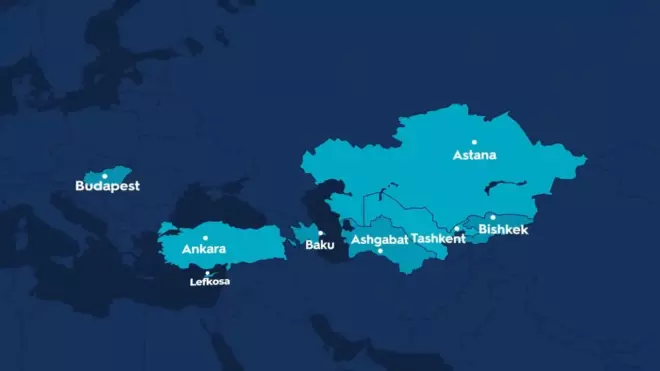
The Organization of Turkic States brings together Turkey, Azerbaijan, Kazakhstan, Kyrgyzstan, and Uzbekistan. Observers include Hungary, Turkmenistan, and the partially recognized Turkish Republic of Northern Cyprus. The organization promotes cooperation in economics, transport, culture, education, and digital development.
Read also:
China takes first place: Over 19,000 foreign-capital enterprises now operating in Uzbekistan
