Despite ongoing discussions about diversifying labor migration, Russia remains the main source of remittances to Uzbekistan. In the first quarter of 2026, the country received $3.8 billion in remittances from migrant workers, of which about $2.75 billion came from Russia. At the same time, new data from the Central Bank show that migration destinations are gradually expanding, while domestic demand for labor remains strong, wages are rising, and unemployment is falling.
According to the Central Bank’s labor market review for the first quarter of 2026, total remittance inflows increased by 13% compared with the same period last year, reaching $3.8 billion.
More significant, however, are the changes in the structure of these inflows. A year ago, Russia accounted for 77.6% of all remittances; its share has now fallen to 72.4%.
In absolute terms, this still represents an enormous amount — approximately $2.75 billion over three months. No other country comes close to such figures.
For comparison, Kazakhstan accounted for 4.1% of remittances, South Korea for 4.1%, and European countries for 3.3%. All other countries combined accounted for 16.2%.
This suggests that claims of a declining dependence on the Russian labor market should be treated with caution. Russia’s share is indeed shrinking, but nearly three-quarters of all remittances from migrant workers are still linked to the Russian economy.
Why Russia’s share is declining
The Central Bank attributes the decline in Russia’s share to several factors.
These include higher costs for work patents for foreign workers, the weakening of the ruble in March, and the gradual expansion of labor migration destinations.
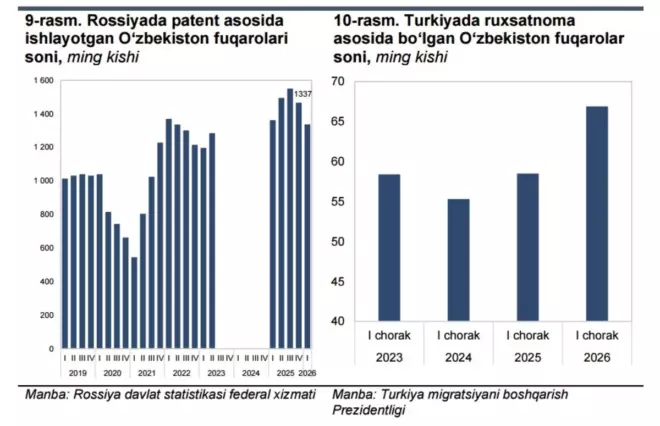
Statistics show that the number of Uzbek citizens working in Russia under patent-based permits reached 1.34 million in the first quarter. This was 8.8% lower than in the previous quarter and 1.8% lower than a year earlier.
At first glance, the decline appears modest. However, it is taking place alongside growing migration to other countries.
In Türkiye, the number of residence permits held by Uzbek citizens approached 70,000. Compared with the same period last year, this figure increased by 14%.
The number of Uzbek citizens in South Korea also continued to rise. According to the review, it reached 99,600 in the first quarter.
Although migration to South Korea and Türkiye remains far smaller in scale than migration to Russia, the trend appears sustainable. For several years, Uzbekistan has sought to diversify organized labor migration by expanding opportunities in South Korea, Japan, Europe, and the Middle East.
Domestic labor market remains active
At the same time, Central Bank data indicate that demand for workers remains strong within the country.
By the end of March, the number of job vacancies had increased by 9.8% year-on-year, reaching 15,400.
The strongest demand for labor was observed in services, retail trade, food services, and manufacturing.
Construction remains more dependent on investment cycles and seasonal factors, although demand for workers also increased in this sector during the quarter.
The high level of hiring activity suggests that the economy continues to create new jobs amid rapid population growth and the annual entry of hundreds of thousands of young people into the labor market.
The number of job seekers is growing even faster
However, labor supply is increasing faster than demand.
According to HeadHunter Uzbekistan, the number of active résumés increased by 31.5% over the year, reaching 636,000.
The growth rate of résumés was more than three times higher than the growth rate of vacancies.
This points to growing competition in the labor market and may become one of the reasons for a gradual slowdown in wage growth in the future.
For employers, this means a wider pool of candidates. For workers, it means greater competition for the best jobs.
The private sector is becoming the main employer
One of the most important trends in recent years has been the growing role of the private sector.
According to the Central Bank, employment in the private sector increased by 5.2% in 2025. Private businesses accounted for the majority of job creation in the economy.
The largest contributions came from financial and insurance services, professional and technical activities, and administrative and support services.
At the same time, employment in agriculture continues to decline.
This reflects structural changes in the economy, as workers gradually move from traditional sectors into services and more modern segments of economic activity.
Unemployment reaches low levels
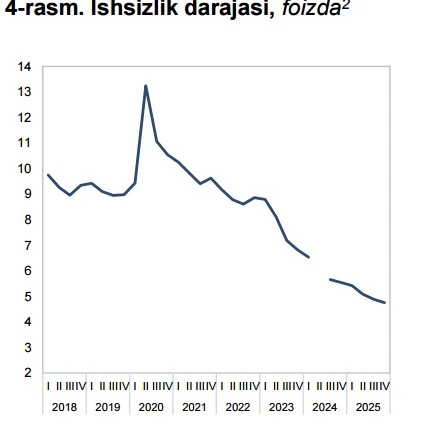
Against the backdrop of rising employment, unemployment has continued to decline.
For the fourth quarter of 2025, the unemployment rate stood at 4.8%.
For comparison, only a few years ago unemployment in Uzbekistan was measured in double digits.
The current figure is among the lowest in recent years and reflects both the expansion of the domestic labor market and the continued outflow of part of the workforce abroad.
Wages are growing faster than productivity
This section of the review is perhaps the most concerning for Central Bank economists.
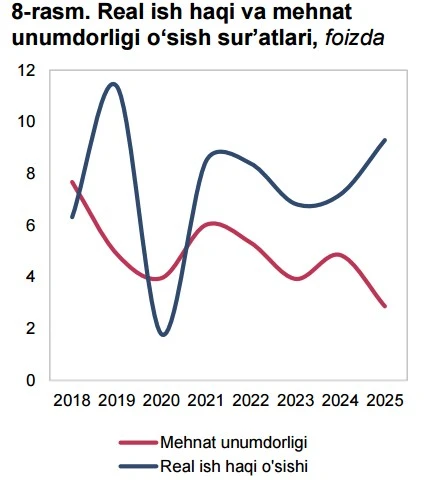
In the first quarter, average nominal wages increased by 17.4%, while real wages — adjusted for inflation — rose by 9.5%.
For workers, this means greater purchasing power.
At the same time, labor productivity is growing much more slowly.
While average productivity growth was about 5% annually during 2018–2025, it has recently slowed to around 3%.
In other words, economic growth is increasingly driven not by greater efficiency but by the expansion of employment and investment.
The Central Bank explicitly notes that wage growth exceeding productivity growth creates additional inflationary pressure.
What the data show
The main conclusion of the review is that Uzbekistan’s labor market remains relatively strong. Employers continue hiring, unemployment is falling, and real incomes are rising.
At the same time, two major challenges remain.
The first is the country’s continued dependence on the Russian labor market, which still generates nearly three-quarters of all remittances to Uzbekistan.
The second is the slowdown in labor productivity growth amid rapidly rising wages.
So far, the economy has managed both challenges successfully. However, the sustainability of future growth will depend not only on the number of jobs created but also on how efficiently labor resources are used within the country.
Also read: