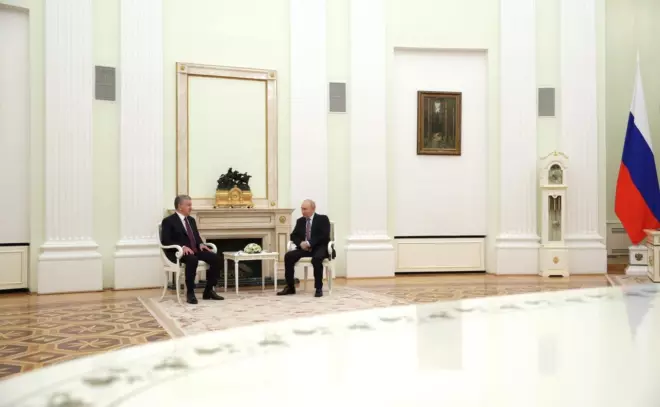
Uzbek President Shavkat Mirziyoyev and Russian President Vladimir Putin held talks in the Kremlin on May 8 ahead of events marking the 81st anniversary of Victory in World War II. Judging by statements released by the two presidential press services, Moscow emphasized the political symbolism of allied ties and Tashkent’s personal support, while the Uzbek side presented the meeting primarily as working talks focused on trade, industrial cooperation, and humanitarian relations.
The Kremlin statement centered on Putin’s remarks that Mirziyoyev’s visit to Moscow was a “special sign” of relations between the two countries. The Russian president directly linked the Uzbek leader’s participation in the military parade to external pressure on states maintaining contacts with Russia.
“The fact that the President of Uzbekistan, despite external signals and threats, is here today and tomorrow will attend the military parade on Red Square together with us and my colleagues is a special sign,” Putin said.
The Russian leader also described relations between Moscow and Tashkent as “not simply friendship,” but “fraternal cooperation.” The Kremlin statement highlighted growing trade, investment cooperation, and Russia’s role in Uzbekistan’s economy.
Mirziyoyev, in turn, described Victory as a “shared history” and a “shared Victory,” stressing the importance of preserving the memory of the war for younger generations.
“I am here so that I can tell my grandchildren, my children, and the younger generation that their grandfathers were heroes. That is the most important thing, and we must never forget it,” the Uzbek president said.
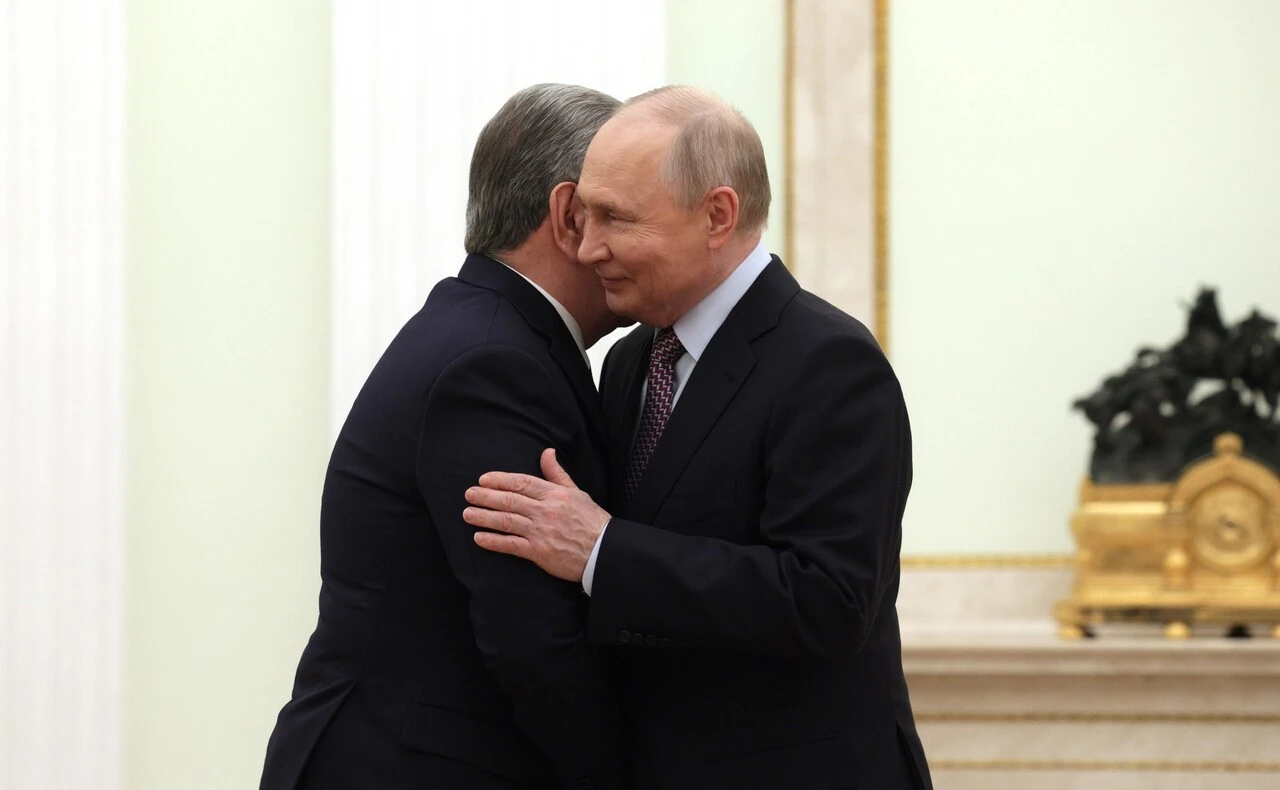
He also spoke about growing trade turnover between the two countries, saying that in the first quarter of the year it increased by 33% compared with the same period last year. Mirziyoyev separately mentioned the Innoprom industrial exhibition and visits by Russian governors and companies to Uzbekistan.
At the same time, the official statement from the Uzbek president’s press service was notably more restrained in tone and almost entirely avoided the political messaging present in the Kremlin’s publication.
The Uzbek statement described the meeting as a discussion on the “further expansion and strengthening of the Uzbek-Russian relationship of comprehensive strategic partnership and alliance.” It focused mainly on trade, industry, energy, metallurgy, and interregional cooperation.
Mirziyoyev’s press service also stressed the importance of “maintaining the dynamics of trade turnover” and accelerating joint projects in priority sectors. It additionally mentioned cultural and humanitarian exchanges as well as discussions on the international agenda, without providing details.
Unlike the Kremlin statement, the Uzbek side did not repeat references to “external threats,” did not use language about “fraternal cooperation,” and did not frame Mirziyoyev’s participation in the military parade as a political signal.
The differences in messaging reflect the traditional approaches of the two capitals to publicly presenting bilateral relations. In recent years, the Kremlin has regularly used visits by foreign leaders to May 9 celebrations as evidence that Russia is not internationally isolated. Tashkent, by contrast, has generally sought to emphasize economic cooperation while avoiding the overt politicization of relations with Moscow.
Related articles: