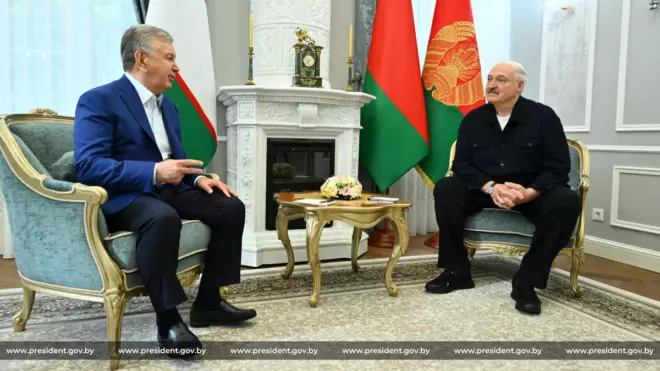
President of Uzbekistan Shavkat Mirziyoyev has concluded a two-day official visit to Belarus that became one of the most significant events in bilateral relations in recent decades. The main outcome of his talks with President Alexander Lukashenko was the signing of a Declaration on the Establishment of a Strategic Partnership, along with a broad package of agreements covering trade, labor migration, industrial cooperation, agriculture, science, culture, and security.
Against the backdrop of Russia’s ongoing war against Ukraine, Western sanctions on Belarus, and growing geopolitical uncertainty, the visit demonstrated the determination of both Tashkent and Minsk to strengthen bilateral ties and seek new economic opportunities within the post-Soviet space.
A Political Signal Amid Regional Turbulence
Although the two sides made almost no direct references to the war in Ukraine in their public statements, the political context of the visit was evident.
“In these difficult times, we truly have much to discuss and exchange views on across all issues,” Mirziyoyev said during a meeting with Lukashenko on July 8, ahead of the formal negotiations.
Belarus remains Russia’s closest ally and has been under Western sanctions since the political crisis of 2020 and the beginning of Russia’s full-scale invasion of Ukraine in 2022. Uzbekistan, by contrast, has pursued a more multi-vector foreign policy, seeking to maintain relations with Russia and China while also expanding cooperation with Western countries.
Against this backdrop, Lukashenko’s remarks about the alignment of the two countries’ foreign policy approaches were particularly noteworthy.
“We follow the same policy as Uzbekistan in the key areas. We are for multipolarity. We do not want to interfere with anyone. We focus on our people, and Uzbekistan focuses on its people. At the same time, we are working very actively to connect our interests,” the Belarusian leader said during the talks.
The reference to “multipolarity” reflects a concept increasingly promoted by Minsk and Moscow, as well as by a number of countries in Asia, the Middle East, and the Global South. For Uzbekistan, the term generally signifies a desire to avoid becoming entangled in great-power rivalries while preserving freedom of diplomatic maneuver.
In their joint statements, the two leaders also reaffirmed their intention to coordinate positions within international organizations, including the United Nations, the Commonwealth of Independent States (CIS), the Shanghai Cooperation Organization (SCO), and the Non-Aligned Movement.
Strategic Partnership After Years of Gradual Convergence
Mirziyoyev described the visit as a historic event.
According to the Uzbek leader, the declaration marks the beginning of a new chapter in interstate relations and confirms both countries’ commitment to the long-term development of a multifaceted partnership.
Lukashenko likewise called the document a “historic step” that formalizes the high level of trust and cooperation between the two states.
The strategic partnership is the logical continuation of an intensive rapprochement that has accelerated in recent years.
“The document officially consolidates the high level of bilateral relations based on the principles of equality, mutual respect, trust, and consideration of each other’s interests. It will provide an additional impetus to cooperation in political, trade, economic, investment, cultural, humanitarian, and security spheres, as well as in addressing modern challenges and threats,” Lukashenko said.
Trade Nears the Billion-Dollar Mark
Economic cooperation was the central theme of the negotiations.
According to the Uzbek side, bilateral trade has nearly tripled over the past five years, reaching almost $1 billion. During the first half of 2026 alone, trade increased by another 30 percent.
Around 360 joint ventures currently operate between the two countries.
“For the first time, I have brought such a large delegation with me—230 Uzbek companies and entrepreneurs are in Minsk today. The forum is being held at the highest level. There are many promising projects,” Mirziyoyev said.
The two sides have now set a new goal: increasing bilateral trade to $2 billion.
To achieve that target, their governments have prepared a comprehensive action plan for 2026–2030.
Lukashenko emphasized that Minsk views Uzbekistan as one of its most important partners in the post-Soviet region. According to him, Uzbekistan ranks among Belarus’s top ten foreign economic partners and is its third-largest partner within the CIS.
The Belarusian president noted that while the two countries had once aimed merely to reach $1 billion in trade, they are now confidently targeting $2 billion.
An important signal came from Lukashenko’s statement that Belarus hopes to use cooperation with Uzbekistan as a platform for entering third-country markets.
“It is very important that, in addition to our joint projects, we are able—with your help—to enter third countries, especially those close to Uzbekistan. There is great interest there, and we will work together. In fact, this work has already begun,” he said.
Industrial Cooperation and Manufacturing
Industrial cooperation occupied a prominent place on the agenda.
Belarus is interested in expanding production of its machinery in Uzbekistan. Lukashenko said joint ventures have already mastered the assembly of 130-ton BELAZ mining trucks and are prepared to move toward even larger models.
Around 1,300 tractors produced by the Minsk Tractor Works (MTZ) were assembled in Uzbekistan in a year, with production potentially reaching 3,000 units annually in the future.
The Belarusian leader argued that such cooperation contributes directly to Uzbekistan’s technological development.
“Production cooperation is the key element. It makes a significant contribution to Uzbekistan’s technological sovereignty,” Lukashenko said.
Other priority sectors include electrical engineering, microelectronics, pharmaceuticals, light industry, and furniture manufacturing.
Energy, Nuclear Power, and Petrochemicals
Energy emerged as another major area of cooperation.
Uzbekistan confirmed its interest in drawing on Belarusian experience in building the country’s first nuclear power plant and related infrastructure.
Belarus, which already operates a nuclear power plant, has offered to share its expertise and personnel.
Lukashenko also expressed readiness to cooperate in the automation and digitalization of energy systems.
In addition, Belarus proposed expanding exports of petrochemical products to Uzbekistan.
At a time of continued volatility in global energy markets and periodic fuel supply disruptions across the region, Minsk is positioning itself as a reliable supplier of petrochemical goods alongside food products and industrial equipment.
Labor Migration Takes on New Importance
One of the most practical outcomes of the visit was the signing of an agreement on the organized recruitment and employment of Uzbek citizens for temporary work in Belarus.
The agreement creates an official framework for bringing Uzbek workers into the Belarusian labor market.
In recent years, Belarus has faced labor shortages due to demographic challenges and significant emigration. As a result, the government increasingly views foreign workers as a way to replenish its workforce.
Lukashenko effectively issued a direct invitation to Uzbek citizens.
“Let us work together. Belarusians have a very positive attitude toward Uzbeks, just as citizens of Uzbekistan have a positive attitude toward Belarusians,” he said.
For Uzbekistan, labor migration remains strategically important. Although migration destinations have gradually diversified, millions of Uzbek citizens still seek employment in Russia. The new agreement opens additional opportunities beyond the traditional Russian labor market.
Agriculture and Food Security
Agriculture formed another key pillar of the negotiations.
Belarus proposed expanding cooperation in livestock farming, poultry production, and agricultural processing.
Specific projects include the further development of a poultry complex in the Tashkent region and the involvement of Uzbek investors in agricultural ventures within Belarus.
Minsk also expressed readiness to supply meat, dairy products, sugar, and goods for Uzbekistan’s state reserves.
As global supply chains face increasing risks, food security is becoming a growing concern for both countries.
A Broad Package of Agreements
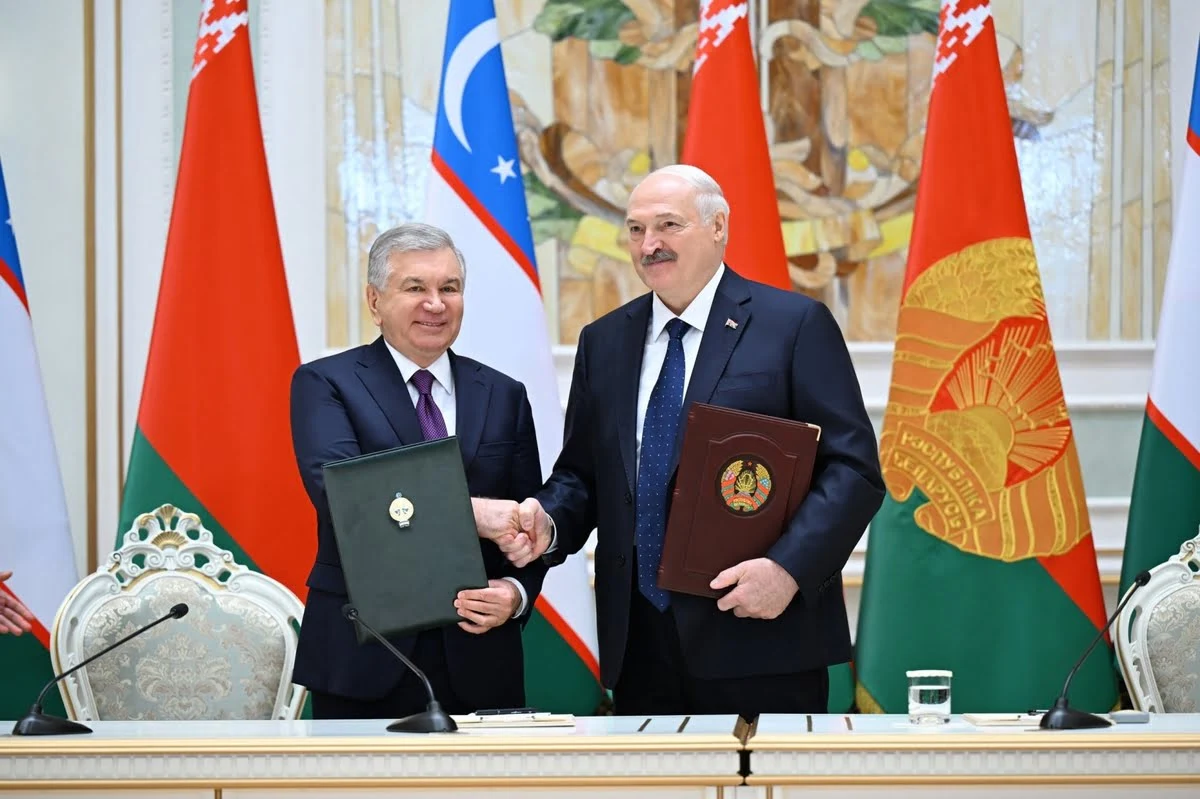
In addition to the strategic partnership declaration, the two sides signed more than a dozen agreements, including:
- a trade and economic cooperation plan through 2030;
- a labor migration agreement;
- a foreign ministry consultation program;
- a forestry cooperation agreement;
- an agricultural development roadmap;
- a tourism cooperation plan;
- a memorandum on social protection;
- agreements between scientific institutions;
- cultural and educational exchange programs.
The two countries also agreed to hold tourism, medical, and education forums before the end of the year.
“We agreed with Alexander Grigoryevich that all of this will remain under the highest level of supervision—at the level of the presidents,” Mirziyoyev said.
Balancing Relations with Moscow While Pursuing an Independent Agenda
Mirziyoyev’s visit to Minsk demonstrated that Uzbekistan continues to strengthen ties with Russia’s allies while maintaining its own multi-vector foreign policy.
Despite the absence of major geopolitical statements regarding Ukraine or relations with the West, the talks underscored both countries’ efforts to adapt to a changing international environment through deeper economic cooperation, expanded production chains, and stronger transport and logistics links.
For Belarus, partnership with the largest country in Central Asia offers an opportunity to offset part of the economic pressure created by international restrictions. For Uzbekistan, it provides access to new markets, technologies, jobs, and additional labor migration destinations.
The declaration signed in Minsk formally codified that course.
Following the conclusion of the talks and the signing ceremony, at Minsk airport, Lukashenko saw the Uzbek leader off before his departure for Tashkent.
Also read:
