On July 24, the fourth court hearing was held in Tashkent in the case of blogger Aziz Hakimov (Comrade Aziz), who is charged with war propaganda, defamation, insult, and incitement of ethnic hatred. Details of the proceedings remain unknown because the trial is being conducted behind closed doors. However, beyond Uzbekistan, the case has already become part of a broader political debate about Russia’s influence in Central Asia.
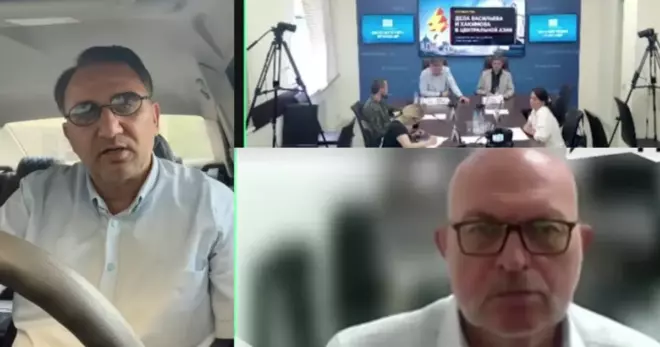
At a roundtable held in Moscow several days earlier, participants discussed Hakimov not only as a defendant in a criminal case but also as one of the representatives of pro-Russian forces in Central Asia.
At the event, organized by the Russian publication Ridus, participants focused less on the charges against Hakimov than on what they described as “pro-Ukrainian forces,” the position of pro-Russian activists in the region, and the relationship between Central Asian states and Russia. The discussion featured Russian journalists, political analysts, and Hakimov’s lawyer Sergey Mayorov, who joined via video link. His remarks demonstrated how far the conversation had moved beyond purely legal issues.
Interest in Hakimov’s case in Russia extends beyond journalists and political commentators. Even before the trial on the merits began, Russian Foreign Ministry spokeswoman Maria Zakharova publicly commented on the situation. She said Moscow was monitoring developments surrounding the blogger, described him as a “long-standing and reliable friend” of Russia, and expressed hope for a “fair and humane” court decision.
Mayorov: a conflict between pro-Russian and pro-Ukrainian bloggers
One of the main themes of the Ridus discussion was the contrast between pro-Russian and pro-Ukrainian forces in the region. Lawyer Sergey Mayorov described blogger Nikita Makarenko as “pro-Ukrainian” and “anti-Russian,” while portraying his client as someone who “has never hidden his pro-Russian position.” According to the defense, the conflict between these two bloggers became the starting point of Hakimov’s criminal prosecution.
Although Mayorov stressed that he could not discuss what was happening inside the closed trial because of a non-disclosure agreement, he presented his own detailed version of the reasons behind the criminal case against his client.
According to Mayorov, the origins of the case lie in a long-running conflict between Aziz Hakimov and Tashkent-based blogger Nikita Makarenko.
The lawyer openly framed the dispute in political terms.
“He is a pro-Ukrainian blogger, and he is also an anti-Russian blogger,” Mayorov said of Makarenko. He described Hakimov as someone who “has never hidden and does not hide his pro-Russian position” and who holds an anti-Ukrainian stance.
In the defense’s view, therefore, this is not simply a dispute between two bloggers but a clash of opposing political views regarding Russia’s war against Ukraine and relations with Moscow.
Kremlin terminology
Particular attention was drawn to the way Mayorov described one of the charges involving images that investigators classified as war propaganda.
Mayorov stated that the case materials contain “nothing about the SMO in Russia” or the “Russian-Ukrainian conflict.” According to him, expert assessments do not specify in whose favor the alleged war propaganda was conducted.
The use of the term “SMO” (“special military operation”) is fully consistent with official Russian rhetoric, which avoids describing Russia’s full-scale invasion of Ukraine since February 2022 as a war.
Four groups of charges
At the Moscow roundtable, Mayorov also outlined the structure of the charges brought against Hakimov while avoiding discussion of the details of the ongoing trial.
According to the lawyer, the prosecution’s case consists of four main parts:
- materials related to Hakimov’s conflict with blogger Nikita Makarenko;
- publication of images that investigators classified as war propaganda;
- publication of a video concerning the private lives of certain public figures;
- publication of materials discussing the Basmachi movement, which allegedly formed the basis for the charge of inciting ethnic hatred.
According to Mayorov, Hakimov does not admit guilt.
Disputes over the length of detention
Mayorov also focused on his client’s pretrial detention.
The defense lawyer argues that procedural deadlines were violated during the investigation. According to him, Hakimov spent about nine months in custody before the trial began, despite legal restrictions and requirements governing extensions of detention. Mayorov says he repeatedly filed complaints with various state agencies.
Complaints about detention conditions
Following the July 24 hearing, Mayorov again commented on his client’s condition.
According to the lawyer, Hakimov continues to complain about health problems that he believes may be related to the quality of water or food in the detention facility. Mayorov also reported a dispute over food brought by relatives for Hakimov’s birthday.
Earlier, the lawyer said that during the investigation Hakimov received treatment in a specialized medical unit within the penitentiary system and required surgery even before his arrest. According to the defense, relatives are permitted to provide necessary medication.
From court proceedings to conspiracy theories
As for the Moscow roundtable, the discussion became even more politicized after Mayorov’s remarks.
Russian political analyst Nikita Mendkovich argued that Hakimov’s prosecution was allegedly linked to the activities of “pro-Ukrainian forces” in Uzbekistan. He claimed that blogger Nikita Makarenko had received support from the United States and was connected to the promotion of foreign investors’ interests and Western capital in the country.
No evidence supporting these claims was presented during the discussion.
Nevertheless, this interpretation became central to the arguments of many participants. Hakimov’s case was portrayed not as a dispute over specific publications but as part of a broader confrontation between pro-Russian and pro-Western forces in the region.
A “new anti-Russia”
Russian journalist Viktor Vasilyev, who previously spent more than a year in detention in Kyrgyzstan on charges of recruiting mercenaries for the Russian army, went even further.
According to him, pro-Russian public figures in Central Asian countries need Russia’s support.
“If we remain silent now, in a couple of years we will end up with a new ‘anti-Russia’ on our doorstep in a huge region with a population of 85 million people,” Vasilyev said.
The discussion was no longer about the fate of a single defendant but about the geopolitical choices facing the region’s states.
“We will revoke that right sooner or later”
The most controversial remarks came from Russian political analyst Alexey Zhivov.
He expressed dissatisfaction with what he saw as Russia’s insufficient support for its allies in Central Asia and then questioned the historical foundations of the sovereignty of post-Soviet states in the region.
According to Zhivov, the countries of Central Asia are “constructed states” that emerged thanks to the Soviet Union.
“A short historical memory, as a result of which they forget who created them and guaranteed their sovereignty, territorial integrity, and right to look to the future, will lead to the fact that we will revoke that right sooner or later,” Zhivov said.
The statement was among the most striking remarks made during the roundtable discussion.
Thus, at the Moscow roundtable, the Aziz Hakimov case was discussed not so much as a criminal proceeding but as part of a broader political confrontation. Participants spoke about conflict between pro-Russian and pro-Ukrainian forces in Central Asia, accused the West of interfering in regional affairs, warned about the emergence of a “new anti-Russia,” and even questioned the historical foundations of the sovereignty of Central Asian states.
Also read:
- Aziz Hakimov sentenced to 4 years and 2 months in prison by Tashkent district court
- Lawyer comments on Aziz Hakimov’s condition after latest court hearing
- Trial on the merits begins in Tashkent against pro-Russian blogger Aziz Hakimov
- Trial in the case of “Comrade Aziz”: case returned to prosecutor amid pressure on the press
- The trial of blogger Aziz Hakimov begins in Tashkent; defense alleges document forgery
- In Uzbekistan, blogger Aziz Hakimov known for promoting Russian propaganda narrative arrested
