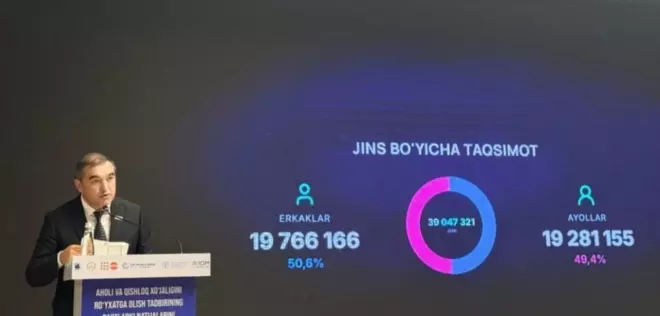
Preliminary results of the first population and agricultural census in the history of independent Uzbekistan showed that the country’s population reached 39,047,321 people.
This is 810,617 more than the current statistical estimate, which put the population at 38,236,704.
The census was conducted from January 15 to February 28, 2026. According to the post-enumeration survey, it covered 97.3 percent of the total population. At the same time, 82.3 percent of residents participated through the online census. The remaining population was counted through door-to-door visits using tablets.
According to the preliminary data, Uzbekistan’s population has doubled compared with the results of the 1989 census. The country recorded 19,766,166 men and 19,281,155 women. The census also counted 56,900 foreign citizens who had been living in Uzbekistan for more than one year. Most of them were citizens of India, Russia and Kazakhstan.
According to the preliminary census results, Uzbeks accounted for 89.4 percent of the population, Tajiks for 3.3 percent, Karakalpaks for 2.2 percent, Kazakhs for 1.8 percent, Russians for 1.6 percent, Kyrgyz for 0.6 percent and Turkmens for 0.5 percent. Representatives of other nationalities made up 0.6 percent of the population.
The census also found that 35.7 million people, or 91.3 percent of the population, identified Uzbek as their native language. This figure is 1.9 percentage points higher than the share of ethnic Uzbeks in the population.
The preliminary results of the agricultural census also revealed significant differences from current statistical estimates. The area of annual crops was 23 percent larger, orchards and vineyards 18.8 percent larger, greenhouses 2.2 percent larger, and fish-farming water bodies 15 percent larger.
Changes were also recorded in livestock numbers. Compared with current estimates, the number of cattle was 14.9 percent lower, sheep and goats 6.2 percent lower, and horses 11.2 percent lower. At the same time, the number of poultry was 12.7 percent higher.
Preliminary census data will be published regularly by the National Statistics Committee.
Also read:
