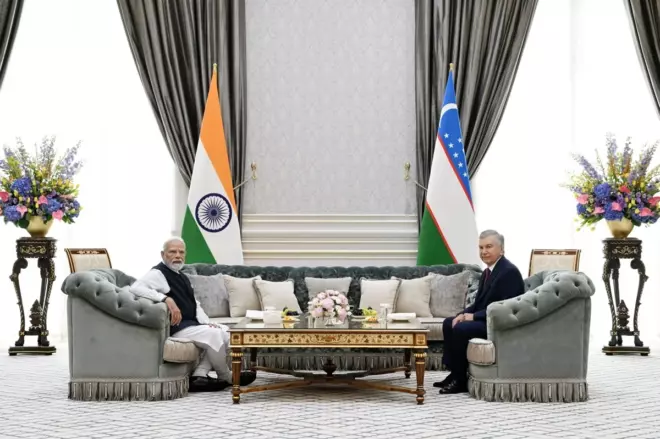
Uzbek President Shavkat Mirziyoyev and Indian Prime Minister Narendra Modi have agreed to elevate relations between their countries to the level of a comprehensive strategic partnership. The announcement was made following talks between the two leaders in Tashkent on August 30.
One of the key economic goals agreed upon during the meeting is to increase bilateral trade to $5 billion by 2030. According to the Uzbek side, trade turnover exceeded $1 billion for the first time in 2025. Over recent years, the number of joint ventures between the two countries has increased sevenfold.
“I am convinced that thanks to our shared aspirations and efforts, our multifaceted and long-term relations will continue to develop dynamically,” Mirziyoyev said.
Modi, for his part, listed the elevation of India-Uzbekistan relations to a Comprehensive Strategic Partnership and increasing bilateral trade to more than $5 billion by 2030 among the key outcomes of the talks. The Indian prime minister wrote about this on X. He also mentioned cooperation in infrastructure, digital public infrastructure (DPI), artificial intelligence, critical minerals, energy and space, as well as expanding market access, connectivity, banking and payment links.
The talks took place at the Kuksaroy residence during Modi’s state visit to Uzbekistan. It was the Indian prime minister’s fourth visit to the country.
From one billion to five
Economic cooperation was one of the central themes of the talks. Tashkent and New Delhi expressed their intention to significantly expand bilateral trade and agreed to take the necessary measures to reach the $5 billion target by 2030.
The two sides also pledged to deepen industrial cooperation and launch new joint projects. Areas identified as particularly promising include energy, electrical engineering, metallurgy, critical minerals, healthcare, pharmaceuticals, agriculture, and the jewelry industry.
Special attention was given to geology and mineral resources. A memorandum of understanding in this field was included in the package of agreements signed during the visit.
The new target represents a substantial increase from current levels. With bilateral trade surpassing $1 billion for the first time in 2025, both countries are now aiming to expand it roughly fivefold within five years.
New mechanisms for political cooperation
Beyond economic ties, Uzbekistan and India agreed to intensify political contacts and exchanges at all levels. This includes cooperation through parliamentary friendship groups, the Intergovernmental Commission, and the Business Council.
To ensure effective coordination, the two countries will establish a dedicated mechanism at the level of their foreign ministries.
The leaders also exchanged views on international and regional issues. According to the Uzbek side, they agreed to continue supporting each other’s initiatives within the United Nations, the Shanghai Cooperation Organisation (SCO), BRICS, and other international institutions.
The issue is particularly relevant for India as Modi is set to attend the upcoming SCO summit in Bishkek following his visit to Tashkent. India has been a full member of the organization since 2017.
Transport, education and culture
Relations between the two countries are developing beyond trade. Currently, 14 direct flights operate between Uzbekistan and India every week. Four Indian universities are active in Uzbekistan.
Cultural cooperation also received renewed attention. Tashkent and New Delhi agreed to regularly organize cultural days, concerts, exhibitions, forums, and film festivals. A Cultural Exchange Programme for 2026–2030 was signed during the visit.
The package of agreements also includes cooperation in higher education and scientific research, tourism, environmental protection, archival affairs, and archaeological research at Fayaztepa and Karatepa.
Separate agreements were reached on cooperation in Ayurveda and other forms of traditional medicine.
India’s cultural presence in Uzbekistan already has an institutional foundation. The Lal Bahadur Shastri Indian Cultural Centre and the Mahatma Gandhi Centre for Indology operate in Tashkent. Uzbek officials also noted the growing popularity of yoga in the country.
Strengthening regional partnerships
Another important area of cooperation is interregional engagement. Partnership links have already been established between Andijan Region and the Indian state of Gujarat, Fergana Region and the state of Haryana, as well as Samarkand Region and Agra.
During the visit, a separate partnership agreement was signed between Samarkand Region and the state of Gujarat.
Such cooperation may become an additional channel for attracting investment and implementing concrete projects by extending interaction beyond central governments to regional authorities.
Modi receives Uzbekistan’s highest friendship award
During the visit, Modi was awarded the Oliy Darajali Do‘stlik Order, one of Uzbekistan’s highest state honors.
According to the presidential decree, the award was bestowed on the Indian prime minister for his personal contribution to strengthening the historic friendship between the peoples of the two countries, advancing strategic partnership, expanding political, trade, economic and investment ties, and promoting cultural and humanitarian exchanges.
The Uzbek side directly linked the award to the outcomes of the visit and the agreement to elevate bilateral relations to a comprehensive strategic partnership.
“Honoured to receive the ‘Oliy Darajali Do’stlik’ Order. I dedicate this to the enduring bond between India and Uzbekistan,” Narendra Modi said.
The two sides also signed a substantial package of bilateral documents. In addition to the joint statement issued after the visit, the agreements cover culture, education, scientific research, environmental protection, economic and financial cooperation, tourism, geology and mineral resources, traditional medicine, and archival affairs.
Separate documents provide for cooperation between the University of World Economy and Diplomacy of Uzbekistan and the Sushma Swaraj Institute of Foreign Service.
The next challenge for Tashkent and New Delhi will be to translate the newly signed agreements into concrete projects. Following the talks, ministries and government agencies were instructed to advance joint programs, while detailed roadmaps with implementation mechanisms, responsible institutions, and timelines are to be prepared for each priority area.
Read also:
