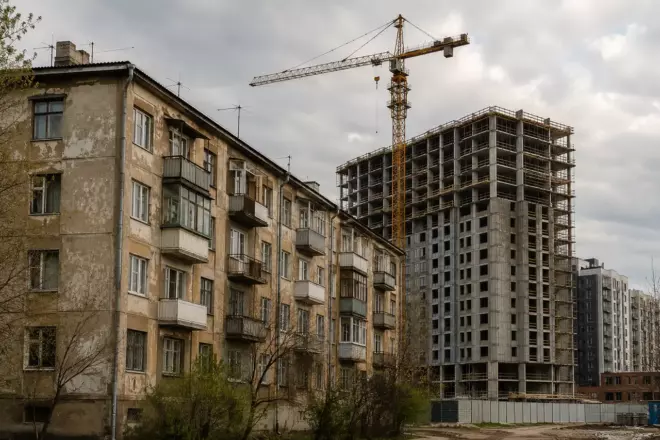
Uzbekistan has adopted the law “On Urban Development Renovation,” which is intended to define the procedure for renewing the old housing stock. Authorities say the program will allow the replacement of dilapidated and outdated buildings with modern housing, improve infrastructure, and raise the quality of the urban environment.
However, for thousands of property owners the main question is much simpler: what will happen to their apartment or house if their area is included in renovation?
The text of the law (attached below in Uzbek) does not answer all questions.
One of the key elements of the new system is owners’ consent. In most cases, inclusion of a property in the program requires notarized consent from at least four-fifths of property owners. Formally, this is a high approval threshold intended to protect residents from decisions made without their participation.
At the same time, the law provides a dispute resolution mechanism through the courts. After the program is approved, individual agreements must be concluded with each owner. If an agreement cannot be reached, the matter may be referred to a court. However, the law does not specify in detail in which cases a court decision may override an owner’s refusal to participate in the project.
The document also contains, at first glance, strong guarantees. It establishes that participation is voluntary, and that state bodies have no right to directly or indirectly force a property owner to include their property in the renovation program. In addition, no one may be deprived of housing without a court decision.
However, alongside these provisions there is a clause allowing for cases in which a court may impose an obligation on the owner to receive compensation. It is precisely this combination of wording that is likely to become the subject of future legal disputes.
Compensation is a central issue in the law. The amount and conditions of compensation must be set out in an individual agreement between the owner, the project directorate, and the relevant territorial renovation fund. The owner is required to vacate the property only after receiving full compensation. After that, they are given up to six months to move out.
The value of the property must be determined by an appraisal organization. The law prohibits investors and project initiators from interfering with appraisers’ work. In addition, at the initiative of owners or by court decision, other appraisal organizations, including international ones, may be involved.
But even if the valuation mechanism works without violations, one question remains that traditionally causes the greatest concern among residents of large cities.
Is the investor obliged to provide new housing in the same district?
The law does not provide a direct answer.
The document allows for the possibility of receiving new housing instead of the old one and establishes the principle of improving the owner’s property conditions. The new property must be better than the previous one. However, the criteria for such improvement are not clearly defined.
The law does not contain a provision guaranteeing the allocation of an apartment in the same district, neighborhood, or within a certain distance from the previous place of residence. It also does not state that an owner from the central part of a city must receive housing in a location of equivalent value.
For residents of Tashkent, this may be a crucial issue. The market value of a square meter often depends not so much on the condition of the building as on its location. An apartment in the city center and an apartment on the outskirts can differ significantly in price even with the same area and construction quality.
That is why, in future renovation projects, the main subject of negotiation will likely be not only the size of monetary compensation but also the location of the new housing.
The law creates a basic legal framework for large-scale urban redevelopment. However, many of the most sensitive issues for property owners—primarily guarantees of remaining in the same district and the limits of court authority in cases of owner disagreement—are formulated in rather broad terms. Answers to these questions are likely to emerge only after the adoption of by-laws and the development of case law.
The law has been signed by the president and will come into force on December 12, 2026.
Read also:
- Housing renovation law in Uzbekistan: up to 17,000 pre-1991 buildings may be replaced with new housing
- Mirziyoyev outlines urban development priorities in Uzbekistan at Baku forum
- Tashkent launches large-scale renovation: which houses will be demolished is still unknown
- Your property has been revalued in Uzbekistan. Should you agree with the new value and what happens next?
Add Yep.uz to your preferred Google sources
Add Yep.uz to your preferred sources in Google to see the site's articles more often in Top Stories.
