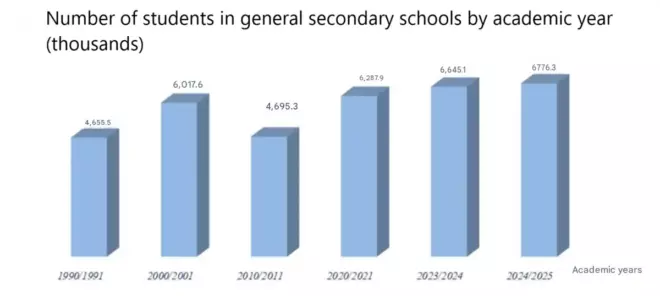
The number of schoolchildren in Uzbekistan is growing faster than school infrastructure. Over the past 35 years, the number of students in general education schools has increased by 2.12 million, or 45.6%, while the number of schools has grown by only 30%. As a result, there are now about 619 students per school on average, compared with 544 in the early 1990s.
Over the past 35 years, the number of schools in Uzbekistan has increased significantly. However, the number of students has grown even faster, reflecting the effects of continued demographic growth and putting additional pressure on the country’s education infrastructure.
According to data from the National Statistics Committee, at the beginning of the 2025/2026 academic year, there were 11,118 general secondary education institutions in the country. Compared with the 1991/1992 academic year, when there were 8,557, the number of schools had increased by about 30%.
At the same time, the number of students increased much more significantly. In the 1990/1991 academic year, 4.655 million students attended general education schools. By the beginning of the 2024/2025 academic year, their number had reached 6.776 million. This was an increase of 2.12 million, or 45.6%.
Thus, since independence, the number of schoolchildren has grown roughly one and a half times faster than the number of schools.
Growth has been uneven
The development of the school network shows that the expansion of education infrastructure has been uneven.
In the early 1990s, the education system experienced rapid growth. By the 1995/1996 academic year, the number of schools had increased to 9,289. By the beginning of the 2000/2001 academic year, it had reached 9,726.
After that, growth virtually stalled. For more than a decade, the number of schools changed very little. There were 9,803 schools in 2005/2006 and 9,806 in 2010/2011. Even by the 2015/2016 academic year, the figure stood at 9,720 schools, below the level recorded a decade earlier.
The situation changed only in recent years. In the 2020/2021 academic year, the country had 10,181 schools, after which sustained growth began. Over five years, the number of general secondary education institutions increased by almost 1,000, reaching 11,118.
This indicates that the government has stepped up investment in education infrastructure against the backdrop of continued growth in the school-age population.
More students per school
Comparing the number of schools with the number of students makes the changes more apparent.
In the early 1990s, there were about 544 students per school on average. By the beginning of the 2024/2025 academic year, this figure had risen to approximately 619: 6.7763 million students were enrolled across 10,943 general secondary education institutions.
The increase cannot be described as dramatic, but it shows that the expansion of the school network has not fully kept pace with the increase in the number of children.
The national average also masks significant regional differences. Schools in rural and sparsely populated areas may be relatively small, while individual schools in major cities can accommodate substantially more students.
This is particularly relevant to Tashkent and rapidly growing regions, where the population is increasing faster than the national average.
That is why the construction of new schools remains an issue even as additional education facilities are being commissioned every year.
Demographics remain the main factor
The main reason for the increase in the number of schoolchildren is demographic growth.
Uzbekistan is the most populous country in Central Asia. Since gaining independence, the country’s population has almost doubled and now exceeds 39 million people. At the same time, more than 45% of the population is under the age of 25.
The effects of this growth are directly reflected in the education system.
Every year, a large new generation of children enters the school system. The Ministry of Preschool and School Education reported that more than 795,000 children are expected to enter first grade in the 2026/2027 academic year.
As of early August, around 680,000 prospective first-graders had already been enrolled, representing 85% of the planned total.
By comparison, in many European countries, the number of children entering first grade each year is considerably lower.
High birth rates create significant human capital and economic potential for the future. At the same time, however, they require the continued expansion of education infrastructure and higher spending on the education system.
More than 550,000 teachers
According to the Ministry of Preschool and School Education, more than 550,000 teachers will work in 10,225 general education schools in the new academic year.
They will be responsible for educating more than 6.7 million students.
Dividing the number of schoolchildren by the number of teachers gives approximately 12 students per teacher.
On its own, this figure appears relatively favorable. However, it does not allow conclusions to be drawn about actual class sizes or the workload of individual teachers.
Teacher statistics include different categories of education workers, while the number of teachers in particular subjects and regions may vary considerably.
Nevertheless, the figures demonstrate the scale of the general secondary education system, which remains one of the country’s largest public sectors in terms of employment.
The private sector continues to grow
Another feature of recent years has been the rapid expansion of non-state education.
According to official statistics, at the beginning of the 2025/2026 academic year there were 551 non-state general education institutions in the country. Compared with the previous academic year, their number increased by 96, or 21.1%.
The largest number of private schools is concentrated in Tashkent, with 145. Fergana Region ranks second, with 121 non-state schools.
They are followed by Samarkand Region with 43 institutions, while Andijan and Namangan regions each have 37 private schools.
Despite its rapid growth, the non-state sector still represents a relatively small share of the country’s overall school system. However, it remains one of the fastest-growing segments of education.
The increase in the number of private schools reflects not only growing demand from parents but also an attempt by the market to partially offset the growing pressure on the state education system.
At the same time, private education remains expensive relative to official incomes. The average nominal monthly wage accrued in Uzbekistan in January–March 2026 was 6.83 million soums while the average wage in education was 4.62 million soums.
Meanwhile, according to published 2026/2027 tuition rates for private schools in Tashkent, monthly fees start at around 4.1 million soums and reach 25 million soums for some international programs. This means that educating one child at some schools can cost an amount comparable to, or substantially higher than, the average monthly wage. Some schools also charge separate admission fees.
New places are being created, but demand remains high
The government continues to expand school infrastructure.
According to the National Statistics Committee, 8,896 student places were commissioned in general and specialized schools across the country between January and September 2025.
More than half of these places were in Samarkand Region, where 4,640 new places were created. Significant numbers were also recorded in Jizzakh, Andijan, Navoi and Surkhandarya regions.
However, the need to further expand the school network remains.
Statistics from recent decades show that the growth in the number of students is a sustained, long-term trend. While the number of schools has increased by roughly one-third over 35 years, the number of students has grown by almost half.
That difference may appear modest on paper, but in practice it represents millions of additional children who need places in schools, textbooks, qualified teachers and modern educational infrastructure.
This is why building new schools, training teachers and creating additional student places remain key priorities for the social sector. Given demographic trends, the need to expand the education system is likely to persist in the coming years, while pressure on it will continue to grow alongside the size of the next generation of schoolchildren.
Also read:
