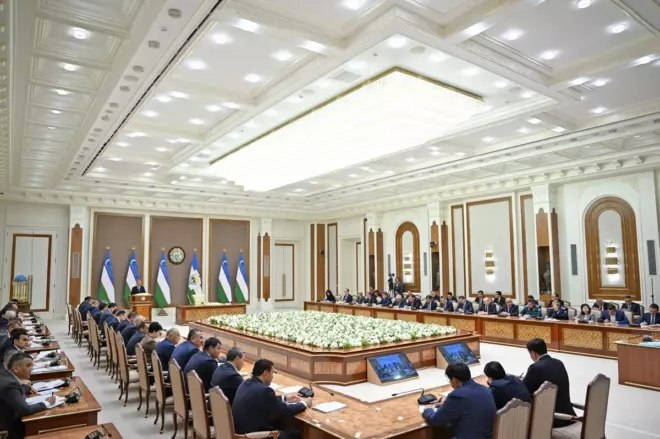
Uzbek President Shavkat Mirziyoyev held a major video conference on July 27 dedicated to the fuel and energy sector. During the meeting, he sharply criticized the industry’s performance, dismissed the minister of energy and the head of a major power distribution company, and warned other senior executives that they could also lose their jobs by the end of the year.
Mirziyoyev: The problem is not money, but management
Despite record investments and large-scale modernization of the energy sector over the past decade, the president said the main challenge is not a lack of funding but poor management, according to presidential press secretary Sherzod Asadov.
“We must say it openly. The problem in the energy sector is not financing, because we find as much money as necessary. The problem is management of the system,” Mirziyoyev said.
According to the president, the sector has attracted $23 billion in foreign investment in recent years. Power plants with a combined capacity of 9.5 gigawatts have been commissioned, creating enough generation capacity to fully cover domestic demand.
In addition, 30 trillion soums have been invested in modernizing electricity and gas networks, substations, transformers, and gas distribution facilities. This is six times more than was invested in the sector during the previous 25 years.
Thousands of accidents and billions of kilowatt-hours lost
Despite these investments, the reliability of energy supply remains a serious concern. Nearly 4,000 power grid failures occurred across the country in June and July alone. As a result, residents and businesses in some areas were left without electricity for up to eight to ten hours.
The president noted that while network structures are similar across regions, some districts operate reliably while others suffer constant disruptions. According to him, this reflects differences in oversight, discipline, and managerial accountability.
Particular attention was paid to rising energy consumption. Electricity use has more than doubled over the past five years in the city of Shirin and in Yangihayot, Yakkasaray, and Akhangaran districts. However, local authorities and utility organizations failed to prepare infrastructure for the growing demand.
Another major problem is energy loss. Electricity losses currently stand at 17.2 percent. Over the past six months, the country lost 4.8 billion kilowatt-hours of electricity. In several districts and cities, losses exceed 25 percent.
The president also pointed to the poor performance of digital metering systems. Although the ASKUE and ASKUG systems have been operating for more than four years, 300,000 gas meters and 234,000 electricity meters are still not transmitting data. As a result, receivables continue to grow in some regions.
A $300 million mistake
Large investment projects were another major topic of discussion. The construction of a combined-cycle gas power plant in Surkhandarya Region came under criticism after it emerged that the site had been poorly selected.
According to Mirziyoyev, an additional $300 million will now be required to build the infrastructure needed to supply gas to the plant. Furthermore, insufficient review of the project’s contractual terms has created a risk of additional expenses. Officials have been instructed to revise the agreement.
Energy minister dismissed
The personnel decisions announced at the meeting were among the toughest in recent years.
Energy Minister Jurabek Mirzamakhmudov was relieved of his duties. Sherzod Khodjayev, who previously headed the Energy Market Development and Regulation Agency, was appointed as the new minister. His nomination had earlier been approved by deputies of the Legislative Chamber of the Oliy Majlis.
The head of Hududiy Elektr Tarmoqlari was also removed from office.
Asrorjon Askarov was dismissed as chairman of the company’s management board due to serious shortcomings identified within the system. Sardor Isakulov was appointed as the company’s new chief executive.
At the same time, the heads of Milliy Elektr Tarmoqlari, Issiqlik Elektr Stansiyalari, Transgaz, and Hududgaz were placed on probation until the end of the year. The president warned that they could also lose their positions if they fail to deliver concrete results.
Akhadkhon Isokjonov was appointed head of the Inspectorate for Control over the Use of Electricity, Petroleum Products and Gas under the Cabinet of Ministers. His predecessor, Dadajon Isakulov, was relieved of his duties after being transferred to another position.
Mirziyoyev stressed that responsibility for the situation in the energy sector lies not only with specialized agencies but also with local authorities.
“Hokims do not have the right to sit back and say, ‘This is the job of energy officials.’ Accountability will be strict,” the president warned.
Yangiyul district to become a testing ground for reforms
Yangiyul district in Tashkent Region has been selected to demonstrate a new approach to energy infrastructure management. A special task force led by Energy Minister Sherzod Khodjayev will be established there. The district is expected to become a model for reliable electricity and gas supply by October 1.
The experience gained there will later be expanded nationwide. Energy company executives will be assigned to the most problematic territories and will be required to work jointly with local authorities to implement a new management system.
Artificial intelligence, private gas suppliers, and new specialists
During the meeting, the president also announced the creation of a Center for Digitalization and Artificial Intelligence in the Fuel and Energy Sector under the Ministry of Energy. The center will analyze the entire chain from energy generation and transmission to distribution and delivery to consumers.
At the same time, the government plans to increase private-sector participation in liquefied gas supplies. Andijan Region will serve as a pilot area. During the first half of the year, only 41,000 tons of liquefied gas were delivered there compared to a planned 48,000 tons, while deliveries are lagging behind schedule in more than 300 mahallas.
Special attention was also given to workforce development. According to the president, around 5,500 specialists for the energy sector graduate each year from 25 technical higher education institutions across the country. However, practical training remains inadequate. Mirziyoyev noted that graduates often need an additional two to three years of work experience before becoming fully qualified professionals.
To address the problem, officials were instructed to completely revise educational programs in fuel and energy specialties within one month and modernize laboratories and training facilities. Starting from the new academic year, half of all third-year students and all fourth-year students will participate in a dual education system combining studies with on-the-job training.
Authorities say these measures are necessary because demand for specialists in new energy projects is rapidly increasing. Thousands of workers will be needed in solar and wind power, electric vehicle charging infrastructure, and other advanced technologies. As an example, officials cited the experience of Saudi Arabia’s ACWA, which is already training specialists at an energy college in Shirin. Beginning next academic year, the model will be expanded to three additional colleges in Karakalpakstan, Bukhara Region, and Navoi Region.
The meeting demonstrated that the government sees the energy sector’s problems not as a lack of investment, but as a consequence of weak management. Following years of record spending, the focus is now shifting toward accountability, digitalization, loss reduction, and personal responsibility for results.
Also read:
- Uzbekistan expands hydropower to reduce dependence on gas and coal
- Mishustin in Tashkent: What Uzbekistan and Russia discussed amid growing trade and the launch of the nuclear power plant project
- Mirziyoyev in St. Petersburg: a nuclear project, trade and a display of alliance amid war
- Putin–Mirziyoyev call marks shift to active phase of nuclear plant construction in Uzbekistan
Add Yep.uz to your preferred Google sources
Add Yep.uz to your preferred sources in Google to see the site's articles more often in Top Stories.
