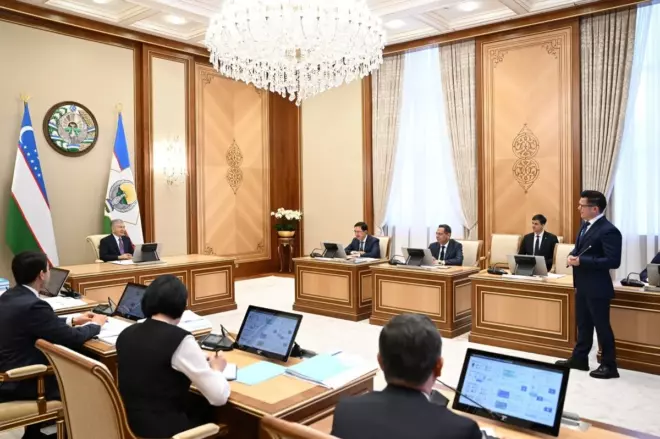
Uzbekistan is seeking to transform itself into one of Central Asia’s leading education hubs. Proposals presented to President Shavkat Mirziyoyev envision the creation of an International University Town in Tashkent, the attraction of leading foreign universities, and the expansion of programs that allow students to study according to international standards.
If implemented, the initiatives could become one of the largest education projects since the country began dramatically expanding access to higher education after 2017.
International university town: inspired by Qatar and the UAE
The most notable new proposal is the creation of an international university town (as described by the Uzbek government) in Tashkent.
According to the plans presented, the site would bring together leading domestic and foreign higher education institutions, educational infrastructure, and student housing in a single location.
The initiative draws inspiration from Qatar’s Education City, Dubai International Academic City in the United Arab Emirates, and the Incheon Global Campus in South Korea.
All three projects share a common idea: instead of sending thousands of students abroad, governments create conditions that encourage foreign universities to establish a presence within the country. As a result, international education becomes more accessible to local students while also attracting young people from neighboring states.
Uzbek authorities have openly stated their ambition to turn the country into a leading educational center in the region. To achieve this goal, they are considering support measures for foreign universities, including simplified licensing procedures, grants and scholarships, construction of campuses and dormitories, tax and customs incentives, and partial compensation of royalty payments.
For Central Asia, the project could create a new competitor to Kazakhstan, which has spent years attracting international universities and educational initiatives.
However, the success of such efforts will depend on more than infrastructure development. International experience shows that leading universities base expansion decisions on factors such as academic autonomy, regulatory transparency, faculty quality, and long-term investment guarantees.
British degrees without full-time study abroad
A second major proposal is the creation of a Higher School of Integrated Educational Programs at the Tashkent University of Architecture and Civil Engineering.
The project would offer programs developed jointly with foreign universities and lead to degrees recognized in Uzbekistan.
At the initial stage, the educational process is expected to be organized in cooperation with the University of Northumbria and the University of Hertfordshire in the United Kingdom. Later, the list of partners could expand to include Italy’s Sapienza University of Rome, the University of Southampton in the UK, and the University of Glasgow in Scotland.
Based on the proposed “1+3,” “2+2,” and “3+1” models, students would combine studies in Uzbekistan with studies at partner universities abroad.
In essence, the initiative aims to bring some of the advantages of Western education into the country while maintaining access to international academic standards and foreign degrees.
For many families, this could provide an alternative to expensive overseas education, which remains beyond the reach of most citizens.
Authorities aim to cut overseas education costs tenfold
The financial aspect of the project may prove particularly attractive to prospective students and their parents.
According to figures presented during the briefing, more than 1,000 students from Uzbekistan are currently enrolled in four-year programs in the United Kingdom. Tuition and living expenses can reach approximately $50,000 per year per student.
Authorities believe that integrated educational programs could reduce these costs by as much as ten times.
Exactly how such savings would be achieved has not yet been explained. The materials presented do not provide detailed information on the structure of the programs, including the duration of study abroad or the cost of studying in Uzbekistan.
For the country, however, the initiative could also help reduce the outflow of financial resources abroad, allowing part of these expenditures to remain within the national education system.
At the same time, much will depend on the actual cost of the new programs. International experience suggests that dual-degree and foreign partnership programs often cost significantly more than standard programs offered by domestic universities.
New opportunities for participants in the El-Yurt Umidi program
Another practical change could involve reforms to the El-Yurt Umidi Foundation.
Until now, the program has primarily been associated with financing the education of Uzbek citizens at foreign universities. The new proposal would extend support to integrated educational programs offered within Uzbekistan.
In addition, authorities plan to introduce a new support mechanism for young people who receive conditional admission to leading universities around the world.
The proposal would cover the cost of the first year of study at a domestic university or within a Foundation program, after which students could continue their education abroad.
This could become an important tool for talented applicants who have received offers from foreign universities but face financial barriers at the initial stage of their studies.
From expanding access to competing in global rankings
The proposals reflect a broader stage in the development of Uzbekistan’s education system.
Over the past eight years, higher education enrollment has increased from 9 percent to 44 percent, while the number of students has grown from 270,000 to 1.7 million.
If the previous phase of reforms focused primarily on expanding access to higher education, the emphasis is now shifting toward educational quality and international recognition.
By 2030, authorities hope to place at least five Uzbek universities among the world’s top 500 institutions, while another ten are expected to enter leading subject-specific rankings.
The government also plans to expand international accreditation of academic programs, introduce foreign educational standards in technical colleges, and send thousands of educators abroad for professional development.
The key question is whether Uzbekistan can move beyond importing individual educational programs and create a fully developed international academic environment within the country. The answer may determine whether the proposed university town becomes just another infrastructure project or evolves into a genuine educational center for Central Asia.
Also read:
