Congratulations from foreign leaders on the 35th anniversary of Uzbekistan’s independence offer an unusual snapshot of Tashkent’s foreign relations. The order in which the messages are published on the president’s official website is not, in itself, an official ranking of partners. But it does draw attention to which countries appear at the very top of the list.
The collection opens with a message from Russian President Vladimir Putin. He is followed by Chinese President Xi Jinping and U.S. President Donald Trump. Next come the leaders of Kazakhstan, Kyrgyzstan, Tajikistan, Turkmenistan, Azerbaijan and Türkiye.
Notably, the same sequence was seen a year ago. In the collection of congratulations published for the 34th anniversary of independence, messages from Vladimir Putin, Xi Jinping and Donald Trump were also placed first.
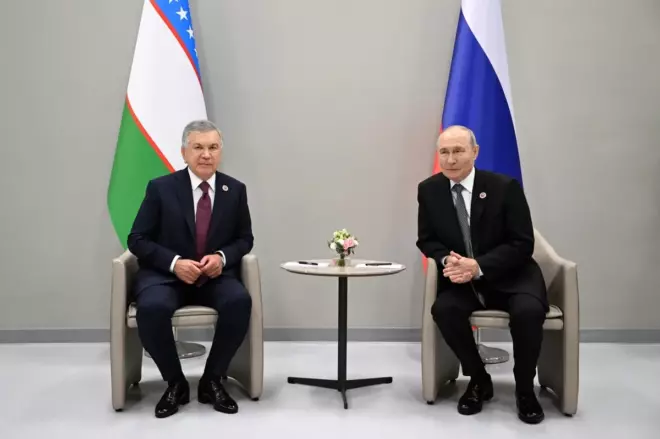
The Russian leader’s first-place position is particularly noteworthy. It came against the backdrop of a personal meeting between Vladimir Putin and Shavkat Mirziyoyev in Bishkek on the same day, August 31.
Putin met with Mirziyoyev in Bishkek on August 31
Following the opening ceremony of the VI World Nomad Games in Bishkek, Putin held a meeting with Mirziyoyev, according to the Russian side.
The Uzbek side said the presidents discussed further expanding and strengthening relations of “comprehensive strategic partnership and alliance.” According to Tashkent, bilateral trade turnover had increased by 12 percent since the beginning of 2026. The two sides also discussed industrial cooperation, projects in energy, metallurgy and transport, interregional contacts and cultural and humanitarian exchanges.
Thus, Putin’s congratulatory message did not appear in isolation: on the same day, Russian-Uzbek relations were highlighted through a personal meeting between the two presidents and discussions of a concrete economic agenda.
At the same time, it would be wrong to conclude from the order of publication alone that Russia is Uzbekistan’s most important foreign-policy partner. The president’s official website does not explain the principle according to which the congratulatory messages are arranged.
China and the United States follow
Immediately after the Russian president comes a message from Xi Jinping. The Chinese leader describes the strategic nature of relations with Uzbekistan and calls the country a “friendly neighbor” and an “all-weather comprehensive strategic partner.”
There is also a direct context here: on August 31 in Bishkek, Mirziyoyev held talks with Xi Jinping on the sidelines of the SCO summit. The two sides discussed trade, investment, industrial cooperation, transport, energy and the construction of the China–Kyrgyzstan–Uzbekistan railway. Tashkent proposed increasing bilateral trade to $30 billion in the coming years; the portfolio of ongoing joint investment projects is estimated at about $60 billion.
Economic indicators confirm China’s particular weight for Uzbekistan. In the first half of 2026, China was the country’s largest trading partner, with trade turnover of $9.47 billion, or 23.1 percent of Uzbekistan’s total foreign trade. Russia ranked second, with $7.01 billion and a 17.1 percent share. Together, the two countries accounted for more than 40 percent of Uzbekistan’s foreign trade.
The gap is even more pronounced in imports. China accounted for about 32 percent of all Uzbek imports, compared with 18.5 percent for Russia — meaning that roughly one in every three dollars spent by Uzbekistan on imports went to Chinese goods.
Donald Trump’s message comes third in the collection. The U.S. president refers to the expansion of the strategic partnership, trade and investment, energy, border security and regional connectivity.
The U.S. track also received follow-up attention directly in Bishkek. On August 31, Mirziyoyev received Sergio Gor, the U.S. Special Envoy for South and Central Asian Affairs. Gor conveyed Trump’s greetings and best wishes to Mirziyoyev on the occasion of Uzbekistan’s Independence Day. The two sides discussed further strengthening the Uzbek-U.S. strategic partnership and implementing agreements reached at the highest level.
The picture is therefore a characteristic one: in the same city and virtually on the same day, Tashkent held separate contacts with representatives of Russia, China and the United States.
Central Asia is a separate level
After Russia, China and the United States, the collection features the leaders of neighboring Central Asian countries. Kazakhstan, Kyrgyzstan, Tajikistan and Turkmenistan emphasize strategic partnership, alliance, good-neighborly relations and regional cooperation in their messages.
This direction is particularly important for Tashkent. Mirziyoyev traveled to Bishkek to participate in the Shanghai Cooperation Organisation summit as well as the “SCO Plus” meeting. During the visit, he held a series of bilateral meetings.
In Bishkek, he also met with Pakistani Prime Minister Shehbaz Sharif. The sides discussed trade, investment, transport and logistics, as well as the implementation of agreements reached following Mirziyoyev’s visit to Islamabad in February.
At the same time, Uzbekistan’s economic geography remains much less evenly distributed than its diplomatic outreach. While Tashkent maintains a broad circle of political partners, China and Russia together account for more than 40 percent of the country’s foreign trade.
Another important meeting took place with UN Secretary-General António Guterres. The talks focused on further developing Uzbekistan’s cooperation with the United Nations and on the international and regional agenda. Guterres also congratulated Mirziyoyev and the people of Uzbekistan on the 35th anniversary of independence.
Russia retains significant weight not only in trade. In the first quarter of 2026, Uzbekistan received $3.8 billion in remittances from migrant workers, of which about $2.75 billion, or roughly 72 percent, came from Russia. Thus, the Russian direction remains important for Uzbekistan simultaneously in trade, employment and household incomes.
And where is Ukraine?
Against this backdrop, the absence of a congratulatory message from Ukrainian President Volodymyr Zelenskyy in the published collection stands out.
This does not mean that Zelenskyy did not congratulate Uzbekistan or that no message was received in Tashkent. However, his name is absent from the list of foreign congratulations published on the Uzbek president’s website on August 31, even though the list includes dozens of heads of state, governments and international organizations.
This is particularly notable because just several days earlier Mirziyoyev congratulated Zelenskyy and the Ukrainian people on the 35th anniversary of Ukraine’s independence, and Zelenskyy publicly thanked the Uzbek president.
The absence of Zelenskyy from the official collection can therefore be recorded as a fact, but it should not be turned into evidence of a change in Tashkent’s position toward Kyiv. One list of congratulatory messages is not sufficient to support such a conclusion.
What does the arrangement show?
Looking at the overall picture rather than individual formulations, the official information surrounding August 31 demonstrates the characteristic multi-vector nature of Uzbekistan’s foreign policy.
Russia remains one of Uzbekistan’s key partners: Putin’s message opens the published collection of congratulations, and he met with Mirziyoyev in Bishkek on the same day. China appears immediately alongside Russia in the list and is simultaneously negotiating with Uzbekistan over tens of billions of dollars in trade and investment. The United States is also represented among the first three messages, while the U.S. special envoy met with Mirziyoyev in Bishkek.
Meanwhile, Chinese involvement in Uzbekistan is also growing through investment. As of May 1, 2026, Uzbekistan had 5,615 enterprises with Chinese capital — more than from any other country. According to the Center for Economic Research and Reforms, China also led in the volume of foreign investment in the first quarter of the year, with $6.4 billion, while Russian investment amounted to $1.1 billion.
This creates an important distinction between Uzbekistan’s two major external partners: Russia retains substantial importance through trade, labor migration and established economic ties, while China is simultaneously rapidly expanding its presence in trade, investment and industrial cooperation.
At the same time, Tashkent continues to demonstrate the particular importance of relations with its Central Asian neighbors, Türkiye, Azerbaijan, Pakistan and international organizations. This, perhaps, is the most revealing feature of the congratulatory list: Uzbekistan does not appear to be a country seeking to choose a single external center of power. Rather, its official diplomatic signal is built around maintaining simultaneous relations with Moscow, Beijing, Washington, European states, its Central Asian neighbors and other centers of influence.
The absence of Ukraine from this long official collection, however, remains a notable detail — especially given that Kyiv publicly confirmed receiving congratulations from Mirziyoyev. That fact is worth noting, but definitive conclusions about the reasons for the decision would, at this point, be speculative.
Also read:
- Mirziyoyev congratulates Zelenskyy on the 35th anniversary of Ukraine’s independence, Zelenskyy responds with thanks
- China strengthens its lead as deficit widens: what Uzbekistan’s foreign trade reveals in the first half of 2026
- China takes first place: Over 19,000 foreign-capital enterprises now operating in Uzbekistan
- Uzbekistan received $3.8 billion in remittances in a quarter as dependence on Russia remains high
- Congratulations on the 34th anniversary of independence: Putin first, but Mirziyoyev emphasizes multi-vector policy
