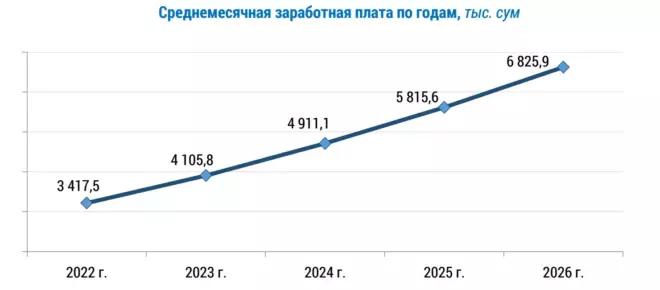
The average monthly nominal accrued salary in Uzbekistan reached 6.83 million soums in January–March 2026, up 17.4% compared to the same period last year. The figures were published by the National Statistics Committee in a new press release attached below (in Russian).
Salary growth has continued for several consecutive years. According to the agency, the average accrued salary stood at 3.42 million soums in 2022, 4.11 million in 2023, 4.91 million in 2024, and 5.82 million in 2025. Over four years, the figure has nearly doubled.
However, the statistics also highlight a persistent divide between the capital and the regions, as well as between high-paying sectors of the economy and social services.
Salary growth dynamics, 2022–2026
| Year | Average salary (thousand soums) |
|---|---|
| 2022 | 3,417.5 |
| 2023 | 4,105.8 |
| 2024 | 4,911.1 |
| 2025 | 5,815.6 |
| 2026 | 6,825.9 |
Tashkent outpaces some regions by nearly 2.5 times
The highest average salary was traditionally recorded in Tashkent at 11.68 million soums per month. At the time of publication, the U.S. dollar exchange rate slightly exceeded 11,986 soums. The capital’s average salary is almost twice the national average and more than 2.5 times higher than in some regions of the country.
Navoi Region ranked second with an average salary of 8.45 million soums. The region remains among the country’s highest-paying areas due to mining and large industrial enterprises.
The lowest figures were recorded in Kashkadarya Region at 4.67 million soums and Surkhandarya Region at 4.72 million soums.
At the same time, the fastest salary growth was recorded not in the capital but in Namangan Region, where wages rose 19% compared to the first quarter of 2025. In Tashkent, salary growth reached 18.8%.
Average salaries by region in January–March 2026
| Region | Average salary (thousand soums) | Annual growth |
|---|---|---|
| Tashkent | 11,684.3 | 118.8% |
| Navoi Region | 8,453.2 | 115.7% |
| Tashkent Region | 6,169.6 | 113.9% |
| Andijan Region | 5,580.9 | 114.4% |
| Bukhara Region | 5,472.1 | 115.7% |
| Syrdarya Region | 5,369.9 | 114.9% |
| Karakalpakstan | 5,318.8 | 114.0% |
| Khorezm Region | 5,302.4 | 114.9% |
| Jizzakh Region | 5,142.8 | 117,3% |
| Namangan Region | 5,099.9 | 119.0% |
| Samarkand Region | 5,069.4 | 116.5% |
| Fergana Region | 5,018.9 | 115.7% |
| Surkhandarya Region | 4,724.2 | 112.1% |
| Kashkadarya Region | 4,665.2 | 114.3% |
Financial sector maintains the largest income gap
The country’s highest salaries remain concentrated in the financial sector. In banking, insurance, leasing, lending, and financial intermediation, the average accrued salary reached 18.6 million soums.
Within the sector, the highest wages were recorded in insurance and reinsurance, exceeding 24.3 million soums.
The information and communications sector ranked second, with average salaries reaching 16.5 million soums. In IT and information services, wages exceeded 21 million soums.
For comparison, the average salary in education stood at 4.62 million soums, while healthcare workers earned an average of 4.11 million soums.
The lowest figure within the education system remained in preschool education, where average salaries were about 2.49 million soums per month. Meanwhile, salaries in higher education exceeded 10.8 million soums.
The divide between high-paying sectors and social services remains one of the most visible structural imbalances in Uzbekistan’s economy.
Average salaries by sector
| Sector | Average salary (thousand soums) | Annual growth |
|---|---|---|
| Finance and insurance | 18,595.8 | 118.2% |
| Information and communications | 16,525.4 | 111.0% |
| Transport and storage | 10,709.3 | 122.5% |
| Industry | 8,025.6 | 116.1% |
| Trade | 7,213.4 | 110.4% |
| Construction | 6,496.1 | 107.2% |
| Arts and entertainment | 5,357.7 | 110.0% |
| Hotels and catering | 5,331.9 | 112.2% |
| Education | 4,615.9 | 114.2% |
| Healthcare | 4,111.6 | 113.0% |
Transport and logistics post the fastest growth
Transport and storage became the fastest-growing sector. Average salaries there rose 22.5% year-on-year to 10.7 million soums.
The increase may reflect the continued expansion of logistics and transport routes across Central Asia, as well as rising demand for warehouse and transit infrastructure.
In industry, the average salary reached 8 million soums. The highest figures within the sector were recorded in mining, where wages approached 11 million soums.
In trade, the average salary stood at 7.2 million soums, although salaries in automobile sales and repair exceeded 10.3 million soums.
Statistics exclude a significant part of the economy
In its published methodology, the statistical agency separately notes that quarterly data are compiled without small businesses, microfirms, and agricultural enterprises.
Full data, including small businesses and farms, are published only once a year.
This means the official average salary primarily reflects conditions in the larger and more formal sectors of the economy. In a country where a significant share of employment remains tied to small businesses, the informal economy, and agriculture, actual incomes for much of the population may differ substantially from the published figures.
In addition, the published data are nominal and do not account for inflation. The statistics show growth in accrued wages in monetary terms but do not directly reflect changes in purchasing power.
Highest and lowest salaries in Uzbekistan, January–March 2026
| Category | Sector/Region | Salary |
|---|---|---|
| Highest regional salary | Tashkent | 11,684.3 thousand soums |
| Lowest regional salary | Kashkadarya Region | 4,665.2 thousand soums |
| Highest sector salary | Finance and insurance | 18,595.8 thousand soums |
| Lowest sector salary | Healthcare | 4,111.6 thousand soums |
| Fastest growth | Transport and storage | 122.5% |
Related article:
Add Yep.uz to your preferred Google sources
Add Yep.uz to your preferred sources in Google to see the site's articles more often in Top Stories.
