
The Barak-Khan Madrasah, located on Hastimam (Hazrati Imam) Square in Tashkent, was built in the first half of the 16th century for the poet and tutor of Tashkent’s princes, Zayniddin Vasifi.
Barak-Khan Madrasah and the story of poet Vasifi
Zayniddin Vasifi was not from Tashkent. He was born in Herat in 1485. He arrived in what is now the capital of Uzbekistan as a mature man, but managed to win the favor of the city’s rulers and was appointed a teacher of literature and mentor to their heirs.
Vasifi is credited with lines that are especially popular among Tashkent tour guides:
Oh, what a kingdom! Even the meadows of paradise
Cannot compare with ancient Shash.
Whoever settles here for long
Will forget forever the gardens of heaven.
Perhaps it is better to die in Tashkent
Than to spend one’s life in any other land!
The poet’s wish came true. After a life full of adventures, he died in Tashkent at the age of either 66 or 81, according to different sources.
Vasifi is best known for his Persian-language book Wonderful Events (Badoye al-Vaqoye), a chronicle of the Shaybanid era that has been translated into many languages. The work contains a considerable amount of subtle satire.
From mentorship to architecture: Nauruz Ahmad Khan
One of Vasifi’s students, Nauruz Ahmad Khan, also known as Barak-Khan, meaning “the fortunate one,” later became a ruler and built a madrasah for his former mentor. Vasifi became its rector, or mudarris (senior teacher).
The Barak-Khan Madrasah is part of a larger architectural complex formed by structures from different periods, including a mausoleum and a khanqah. The portal vault is designed as a deep niche, while the tympanums above the entrance and the supporting elements are decorated with carved brickwork and colorful mosaics.
The building has been restored several times over the centuries and was even fitted with an additional dome at one stage.
The mausoleums of Suyunchkhoja Khan and Barak-Khan
In addition to classrooms, the madrasah housed the mausoleum of Suyunchkhoja Khan, a ruler of Tashkent from the Shaybanid dynasty, as well as an empty mausoleum intended for Barak-Khan himself. However, he was ultimately buried in Samarkand rather than in Tashkent.
A visit to remember: Madeleine Albright and Hastimam
Before the restoration of the square, the Barak-Khan Madrasah housed the Spiritual Administration of Muslims of Uzbekistan.
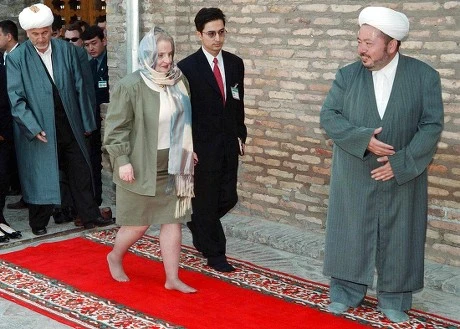
I had the opportunity to visit it in April 2000 as part of the press entourage accompanying then U.S. Secretary of State Madeleine Albright during her visit to Tashkent. I still remember the excitement among local cameramen when Albright removed her shoes before entering the grounds of the Administration. Some of them even applauded.
Following her example, we removed our shoes as well. All the women present, including Albright, wore headscarves. The atmosphere was intimate, respectful, and almost private. It is a scene that has stayed with me ever since.
Souvenir shops today: what remains of the spiritual center?
Today, visitors no longer remove their shoes when entering the Barak-Khan Madrasah. The complex is now occupied largely by souvenir shops.
They are worth a visit out of curiosity, although the prices are often heavily inflated. On the other hand, no one prevents you from bargaining.
Also read:
- Namazgoh Mosque and the Tashkent Islamic Institute
- Hazrati Imam — the holy patron of Tashkent and his mausoleum
- Qur’an of Uthman in the Tashkent Museum: Muyi Muborak and Khast-Imam (updated in 2026)
Add Yep.uz to your preferred Google sources
Add Yep.uz to your preferred sources in Google to see the site's articles more often in Top Stories.
