Property owners in Uzbekistan have discovered new values assigned to their homes. The new figures are often several times higher than the previous cadastral values, and the my.gov.uz website now asks owners whether they agree with the valuation or not. Here is what is currently known — and what remains unanswered.
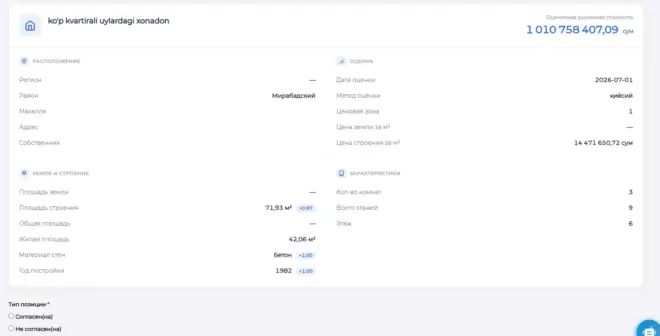
On the evening of September 5, I found the following notification on the portal:
“🏠 Your home has been valued!
The result of the mass valuation of your residential property in Tashkent has been published. View the result on the ‘View valuation results’ page and share your feedback within 60 days. Your opinion matters to us!“
After following the links, I learned that the value of my property had increased significantly. At the same time, the system offered me two options: “Agree” or “Disagree.” What should owners choose, and should they respond at all? That appears to be one of the most widely discussed questions among property owners today.
At the same time, officially published materials currently refer only to preliminary mass valuation results. The Ministry of Economy and Finance has stated that these results are open for public discussion for 60 days. Property owners have the right not only to review the final value but also to examine the data used in the calculation, obtain explanations, and request a review of the result.
The document and valuation methodology
The methodology for the mass valuation of real estate, intended to replace the previous approach based primarily on cadastral values, was approved in Uzbekistan in May (the document in Uzbek is attached below). The new system provides for determining values for apartments, private houses, and commercial properties that are as close as possible to market prices. It is a large-scale reform that will affect virtually every property owner in the country.
According to the document, mass valuation is to be carried out by the National Center for Mass Real Estate Valuation under the Cadastral Agency. Properties are grouped according to similar characteristics, after which values close to market levels are determined using unified methodologies and coefficients.
One of the most significant innovations is the use of real market data. The government plans to analyze property sale and rental listings, data from electronic trading platforms, notarized transactions, information from real estate agencies, and bank data on collateral values. Information from open sources, mass media, and even social media may also be used.
A detailed dataset is compiled for each property. It includes the address, cadastral number, information about the owner, land area, building area, number of floors, apartment floor, number of rooms, availability of utilities, intended use of the property, and its cadastral value.
The methodology assumes that location becomes one of the most important factors in determining value. The assessment is expected to take into account the level of territorial development, infrastructure, utility networks, social facilities, transport accessibility, and other characteristics of the area. For private houses and commercial properties, the methodology provides for territorial zoning, meaning that property values may differ substantially even within the same city.
For apartment buildings, values are calculated using adjustment coefficients. Factors may include apartment size, number of rooms, floor level, year of construction, and other characteristics. At least three comparable market properties are expected to be used in determining benchmark prices.
Particular attention is paid to the condition of the property. The methodology states that if necessary information is missing from the cadastral database, the property will be assessed using standard coefficients. The document notes that the actual condition of renovations may not be taken into account and that properties may be treated as being in average condition. This means that expensive renovations may not always be directly reflected in the final valuation.
For private houses, the valuation consists of two main components: the value of the land plot and the value of the buildings. Factors include land area, building size, wall materials, year of construction, and other characteristics. The document contains separate coefficient tables for different types of residential houses.
A separate methodology is provided for non-residential real estate. Commercial properties are divided by type of activity and category of use. Calculations must take into account land area, building area, engineering infrastructure, and the characteristics of the property itself. Depending on the type of property, comparative, cost-based, or income-based approaches may be used.
One of the most notable features of the document is the format of the final reports. These reports compare the existing cadastral value with the new valuation, which is intended to be close to market value. Moreover, the reporting forms specifically calculate the difference between the two figures and indicate that the new value may be several times higher than the existing one.
At the same time, the methodology contains an important caveat. One of the sample valuation reports states that, taking into account recommendations from experts of the International Monetary Fund and the World Bank, the assessed value may be set at up to 30 percent below market value. This provision is intended to reduce the risk of inflated mass valuation results.
Once the valuation process is completed, the results must be published on the official website of the Cadastral Agency. Property owners will be able to obtain information about their properties by entering the cadastral number. They will have access to information on the property’s value, the calculation method, the coefficients applied, and other valuation elements.
The document also provides for a mechanism of public oversight. The results of the mass valuation are to be submitted for public discussion for 90 calendar days. During this period, property owners may submit comments and objections, which must be reviewed by the authorized body within one month.
However, in August 2026, when reporting the preliminary results of the pilot valuation in Tashkent, the Ministry of Economy and Finance specified a 60-day period for property owners to review the results and submit comments. Thus, while the methodology itself provides for 90 days, the official announcement regarding the current stage of the pilot valuation refers to 60 days. The same 60-day period is also indicated on the my.gov.uz website.
If a property owner disagrees with the final valuation, they may appeal either to a special commission or directly to a court. Complaints will be reviewed by a commission consisting of at least five members. A representative of the Cadastral Agency must be included in its membership.
The methodology provides for a system of upward and downward adjustment coefficients. These include factors such as the year the building was constructed, the floor on which an apartment is located, the number of rooms, floor area, and other parameters.
The methodology does not specify exactly where the new property value will be used. It only states that a valuation close to market value is determined for purposes established by legislation.
Where did the new figures come from?
The new value assigned to your property is the result of the mass valuation carried out under the methodology discussed above. The calculation uses data such as floor area, number of rooms, floor level, year of construction, location, and other characteristics of the property. The new valuation is intended to be as close as possible to market value.
Early results show that the new valuation can differ significantly from the cadastral value.
According to the pilot valuation conducted in Tashkent, the value of more than 600,000 apartments increased from a combined cadastral value of 57.8 trillion soums to 426.7 trillion soums. For more than 213,000 private houses, the difference was even greater, rising from 39.1 trillion soums to 548.4 trillion soums.
“The valuation results also demonstrated significant differences in real estate values across different areas of Tashkent. In particular, the value per square meter of apartments ranged from UZS 4.6 million to UZS 35.8 million, while the value per 100 square meters of land ranged from UZS 115 million to UZS 890 million,” the Ministry of Economy and Finance reported in August.
This is why many property owners are now seeing figures that differ dramatically from those listed in their cadastral documents.
Importantly, the new figure currently displayed in the system does not automatically mean that the government has already recognized it as the property’s final value. The Ministry’s official announcement refers to preliminary results of the pilot mass valuation that are open for discussion for 60 days. Property owners may review the data used in the calculation, obtain explanations, and request a reconsideration of the result.
Why is the new valuation being introduced?
This is where things become particularly interesting.
The methodology itself merely states that the value is determined for purposes provided by legislation. However, documents related to the implementation of the mass valuation system mention real estate transactions, pledge, taxation, and the acquisition of property for public needs among the intended areas of application.
In other words, the connection to the acquisition of property for public needs (including potential redevelopment projects if property acquisition mechanisms are used there – Yep.uz) is explicitly mentioned in a presidential decree. However, the decree does not state that compensation will automatically be paid according to this valuation. It merely includes property acquisition among the areas for which the mass valuation system is being created.
At the time of publication of this article, there is no publicly known decision stating that the published pilot valuation results in Tashkent are already being used to recalculate property taxes. At the same time, the presidential decree calls for the preparation of proposals to change the tax base for property and land taxes after the completion of the Tashkent pilot project.
What the review of two real apartments revealed
For one three-room apartment of almost 72 square meters in Mirabad District, the system determined a value of about 1 billion soums. For a two-room apartment of 46 square meters in Chilanzar District, the valuation came to approximately 535 million soums.
The published calculations also reveal some of the coefficients used. For example, an apartment built in 1964 received a downward coefficient of 0.91 based on the year of construction, while an apartment built in 1982 received a coefficient of 1.0.
For the 72-square-meter apartment, a downward coefficient of 0.97 was applied based on its size, while the 46-square-meter apartment received an upward coefficient of 1.11. Concrete walls carry a coefficient of 1.0. Mirabad District falls within the first pricing zone, while Chilanzar belongs to the second.
All of this shows that the system uses a far more complex valuation model than may appear at first glance.
Should you click “Agree” or “Disagree”?
There is currently no detailed official explanation answering this question.
The published documents only indicate that property owners may review the valuation results and submit objections within the established period.
Therefore, before choosing either option, it makes sense to verify the information about the property:
- floor area;
- number of rooms;
- floor level;
- year of construction;
- address;
- other property characteristics.
If any of this information is incorrect, there are clear grounds for filing an objection.
When does it make sense to disagree?
Challenging the valuation appears reasonable if:
- the property’s characteristics are incorrect;
- the valuation clearly does not correspond to market prices for comparable properties;
- incorrect information was used in the calculation.
If the data are accurate and the valuation falls roughly within the market range, the grounds for challenging it may be considerably weaker.
Should you click “Agree”?
As of the publication of this article, it is unknown what consequences the “Agree” option may have.
If the government is simply collecting feedback from citizens, the difference may be minimal.
However, if the selection is later treated as confirmation that the owner has reviewed the valuation and has no objections, then there may be little reason to rush into clicking “Agree.”
Among the options:
- click “Agree”;
- click “Disagree”;
- choose nothing at all,
the most cautious approach at present appears to be not selecting anything until it becomes clear what legal consequences, if any, each option carries, and how those choices could affect future property taxes or the valuation of property in the event of redevelopment or acquisition for public needs.
If you are not confident that the new valuation is correct, you should not click “Agree” simply because the system offers that option. First review the data on which the valuation is based. If you discover an error or believe the value is unjustified, use the available procedure to file an objection and request a review.
If all property characteristics are listed correctly and you see no grounds to challenge the result, the mere appearance of a new valuation does not mean you need to immediately agree with it. At this stage, these are preliminary mass valuation results that have been released for public discussion. Officially, property owners have the right to review the results and the data used, obtain explanations, and request a reconsideration.
As for the “Agree” button itself, an important gap in the public explanations remains. It has not been publicly clarified whether clicking this button merely confirms that the owner has reviewed the result, or whether it could have any consequences for future challenges to the valuation. Therefore, if you have doubts about the result, I would not recommend confirming your agreement without a clear understanding of the implications.
The responsible authorities now need to provide detailed public clarification. Until they do, the number of questions among property owners is likely to continue growing.
Read also:
- Renovation, Uzbek-style: what the law promises property owners and what it leaves unsaid
- Housing renovation law in Uzbekistan: up to 17,000 pre-1991 buildings may be replaced with new housing
- Tashkent launches large-scale renovation: which houses will be demolished is still unknown
- Mirziyoyev outlines urban development priorities in Uzbekistan at Baku forum
