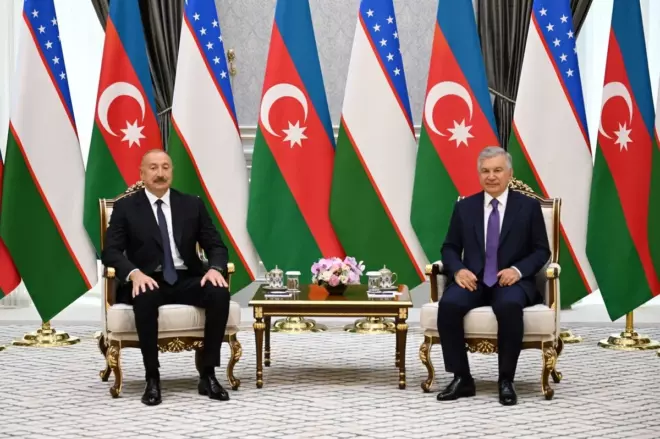
Uzbekistan and Azerbaijan elevated their bilateral relations to a new level on August 23 by signing a Treaty on Eternal Friendship. At the same time, the two sides signed a package of agreements covering trade, investment, culture, tourism, and social security, aimed at the long-term development of bilateral relations.
The Treaty on Eternal Friendship was the central outcome of Azerbaijani President Ilham Aliyev’s state visit to Tashkent and reinforced the two countries’ course toward deeper political, economic, and humanitarian cooperation. Against the backdrop of the growing importance of transport corridors linking Central Asia and the South Caucasus, the agreement reflects Tashkent and Baku’s ambition to turn years of partnership into a long-term alliance.
The third meeting of the Supreme Interstate Council at the Kuksaroy residence showed that Tashkent and Baku are seeking to move their relationship beyond friendly partnership toward a deeper and more enduring format. Behind the official statements are concrete economic projects, billions of dollars in investment, transport routes, educational initiatives, and growing interdependence between two countries that increasingly view each other as strategic partners.
“The signing of the Treaty on Eternal Friendship following the summit will reaffirm this. Most importantly, every aspect of our strategic partnership and alliance is being translated into concrete, tangible results,” Uzbek President Shavkat Mirziyoyev said.
Aliyev, meanwhile, described the current stage of relations with Uzbekistan as unprecedented in an interview with the National Information Agency of Uzbekistan (UzA) several days before his visit. According to him, the leaders of the two countries have made 15 reciprocal high-level visits over the past five years. The current state visit was Aliyev’s third state visit and his seventh visit to Uzbekistan overall. During the same period, the two countries signed the Declaration on Further Strengthening the Strategic Partnership and the Treaty on Allied Relations, which established the legal foundation for the current format of cooperation.
“Interstate relations [between Azerbaijan and Uzbekistan] … have entered a period of unprecedented development in recent years, risen to the highest level — that of alliance — and acquired entirely new content,” Aliyev said in the interview.
From symbolic gestures to economics
Just a few years ago, relations between Tashkent and Baku developed relatively quietly and rarely attracted much attention. Over the past five years, however, cooperation has accelerated significantly.
According to Aliyev, bilateral trade reached $795 million in 2025, more than tripling from the previous year. In January–May 2026, trade between the two countries increased by another 33 percent compared with the same period a year earlier.
The two governments are now setting a new target of raising bilateral trade to $1 billion. One of the key instruments of economic cooperation is the Azerbaijan-Uzbekistan Investment Company, with capital of $500 million, established three years ago to finance joint projects in both countries.
The cooperation extends beyond trade. Projects are already being implemented in energy, chemicals, mining, textiles, agriculture, and urban development. During the current visit, the two sides announced new joint initiatives in banking and finance, the oil and gas industry, tourism, housing construction, and building materials.
Another area of cooperation is the export of renewable energy. In 2025, Azerbaijan, Kazakhstan, and Uzbekistan established the Green Energy Corridor Association, a joint structure intended to coordinate the project for transmitting electricity across the Caspian Sea toward European markets.
This diversification suggests that both sides are seeking to avoid dependence on one or two major projects and instead build a broader network of economic ties.
In his interview ahead of the visit, Aliyev singled out two major Azerbaijani projects in Uzbekistan — the Ritz-Carlton hotel and residential complex under construction in Tashkent, being developed by PASHA Holding, and the Sea Breeze Uzbekistan resort in the Tashkent region.
Sea Breeze as a symbol of a new phase
The most prominent Azerbaijani investment project in Uzbekistan today is Sea Breeze Uzbekistan on the shores of the Charvak Reservoir.
The project, valued at around $5 billion, is being developed by Agalarov Development, owned by businessman Emin Agalarov, the former son-in-law of Azerbaijani President Ilham Aliyev. In August 2025, the Uzbek government officially approved construction of the year-round resort on a 577-hectare site.
The project has received an unusually high level of government support. The investor was granted long-term lease rights, a special procedure for construction, and significant incentives. The development is expected to include hotels, residential complexes, beach infrastructure, sports facilities, and educational institutions.
Despite environmental disputes and public debate over development along the Charvak shoreline, Sea Breeze remains one of the largest examples of Azerbaijani investment in Uzbekistan and demonstrates the level of trust between the political leaderships of the two countries.
For Baku, the project offers an opportunity to strengthen its economic presence in Central Asia. For Tashkent, it is a way to attract major private capital to the tourism sector.
During the visit, the two presidents officially launched construction of the Sea Breeze Uzbekistan residential and recreational complex.
Azerbaijan is also expanding its presence in Uzbekistan’s energy sector. During the visit, the presidents launched five new SOCAR filling stations. The Azerbaijani state oil company already cooperates with Uzbekistan in the oil and gas industry. The joint venture Turan Energy AFEZCO, established by SOCAR and Uzbekneftegaz, is involved in exports to Uzbekistan of high-pressure polyethylene produced by Azerikimya. Another joint venture, Neftegaztexnologiya, established on the basis of the Uzbek institute O’ZLITINEFTGAZ and SOCAR NIPI Nefteqaz, has operated in the oil and gas sector since 2016.
The Middle Corridor gains importance
Transport connectivity was a major topic of the talks.
The two leaders emphasized the need to jointly develop the Middle Corridor, a route connecting China, Central Asia, the Caspian Sea, the South Caucasus, and Europe while bypassing Russia.
Aliyev also directly linked the development of the Middle Corridor to the future China–Kyrgyzstan–Uzbekistan railway. According to him, integrating the new route with transport corridors running through Azerbaijan could create additional transit opportunities for the entire region.
The importance of this transport route has grown substantially in recent years. Geopolitical changes, sanctions, and efforts by many countries to diversify logistics chains have increased demand for alternative routes.
For Uzbekistan, Azerbaijan is becoming an important transit link on the route to European markets. For Azerbaijan, Uzbekistan is becoming one of its key partners in Central Asia and an important source of cargo flows.
This is why transport cooperation is gradually becoming one of the fundamental elements of bilateral relations.
Culture as an instrument of diplomacy
Unlike many international summits, the current visit was marked not only by an economic agenda but also by extensive humanitarian cooperation.
The new building of the National Pedagogical University named after Nizami Ganjavi was opened, while construction of Azerbaijan Park in New Tashkent was launched.
The two sides also proposed producing a joint film, The Literary Bridge between Nizami Ganjavi and Alisher Navoi. Azerbaijan will host the second Forum of Rectors of leading universities of the two countries this autumn.
Such projects matter beyond the cultural sphere. They create long-term social ties that can sometimes prove more durable than political agreements.
For Uzbekistan and Azerbaijan, this is particularly important because both countries actively promote the idea of a common Turkic cultural space as one element of their foreign policy.
Youth and sports
Youth policy is becoming another area of cooperation.
In 2027, Uzbekistan and Azerbaijan will host the FIFA U-20 World Cup. In this context, the two sides have agreed to develop a large-scale “Two Countries — One Championship” program.
It is expected to include joint sports, youth, and cultural events. The model would allow the international tournament to serve not only as a sporting event but also as a platform for promoting both countries internationally.
For states seeking to strengthen their international image and attract investment, such projects have additional significance.
A political signal for the region
In addition to the Treaty on Eternal Friendship and the Decision of the Third Meeting of the Supreme Interstate Council, the two sides signed a package of intergovernmental and interagency documents covering the economy, culture, tourism, social security, and interregional cooperation.
Among the key documents are a program to increase bilateral trade to $1 billion by 2030, an action plan to implement agreements on investment and trade, and agreements on cooperation in social security, culture, and tourism.
The two sides also signed cooperation programs between their foreign ministries and justice ministries for 2027–2028, a memorandum on exchanging experience and cooperation in the field of cynology, and protocols establishing sister-city relations between Urgench and Khankendi, Bukhara and Lachin, and Urgench and Nakhchivan.
The signing of the Treaty on Eternal Friendship can be viewed as a political signal not only to the two countries but to the wider region.
In recent years, Uzbekistan has consistently strengthened ties with the Central Asian states, Türkiye, and Azerbaijan. Baku, in turn, has been expanding its presence in Central Asia through investment projects, transport initiatives, and humanitarian cooperation.
The result is an emerging network of relations based not only on cultural affinity but also on pragmatic economic interests.
In his UzA interview, Aliyev also highlighted the decision taken at the 2025 Consultative Meeting of the Heads of State of Central Asia in Tashkent to grant Azerbaijan full participation in the mechanism. According to him, the previous “C5” format has effectively evolved into a “C6” format, reflecting Azerbaijan’s growing role in regional affairs.
On August 23, Mirziyoyev was awarded Azerbaijan’s highest state honor, the Heydar Aliyev Order, while Aliyev received Uzbekistan’s highest state award, the Order of Oliy Darajali Dustlik.
Also read: