
The Dary Belarusi chain of stores in Tashkent sells Belarusian-made products, including sausages, dairy products, canned goods, fish, bread (locally produced), and other food items. So far, I have no complaints about the quality of the products. However, there is another issue that is just as important in retail as product quality — price labels.
I first visited the store near Ming Urik metro station about one or two months ago. The assortment seemed decent, and the prices were roughly in line with other stores in Tashkent or slightly higher. However, one odd detail immediately caught my attention: many products had no price labels. Sometimes a price label is present, but the item is charged at a higher price at the checkout.
Until recently, I treated this as a minor inconvenience. But yesterday I decided to get to the bottom of it.
I was buying apple pastila and a sausage made from offal with mushrooms (saltison). There was no price label on the sausage product at all. The pastila did have a price label — 90,000 soums per kilogram.
The saleswoman persuaded me to take all the remaining pastila from the shelf — more than 1.7 kilograms. I agreed. The items were scanned, I paid, and left.
I only examined the receipt carefully once I got home. It turned out that the pastila had been charged at 115,000 soums per kilogram. Moreover, the receipt listed it not as regular apple pastila, but as raspberry pastila.
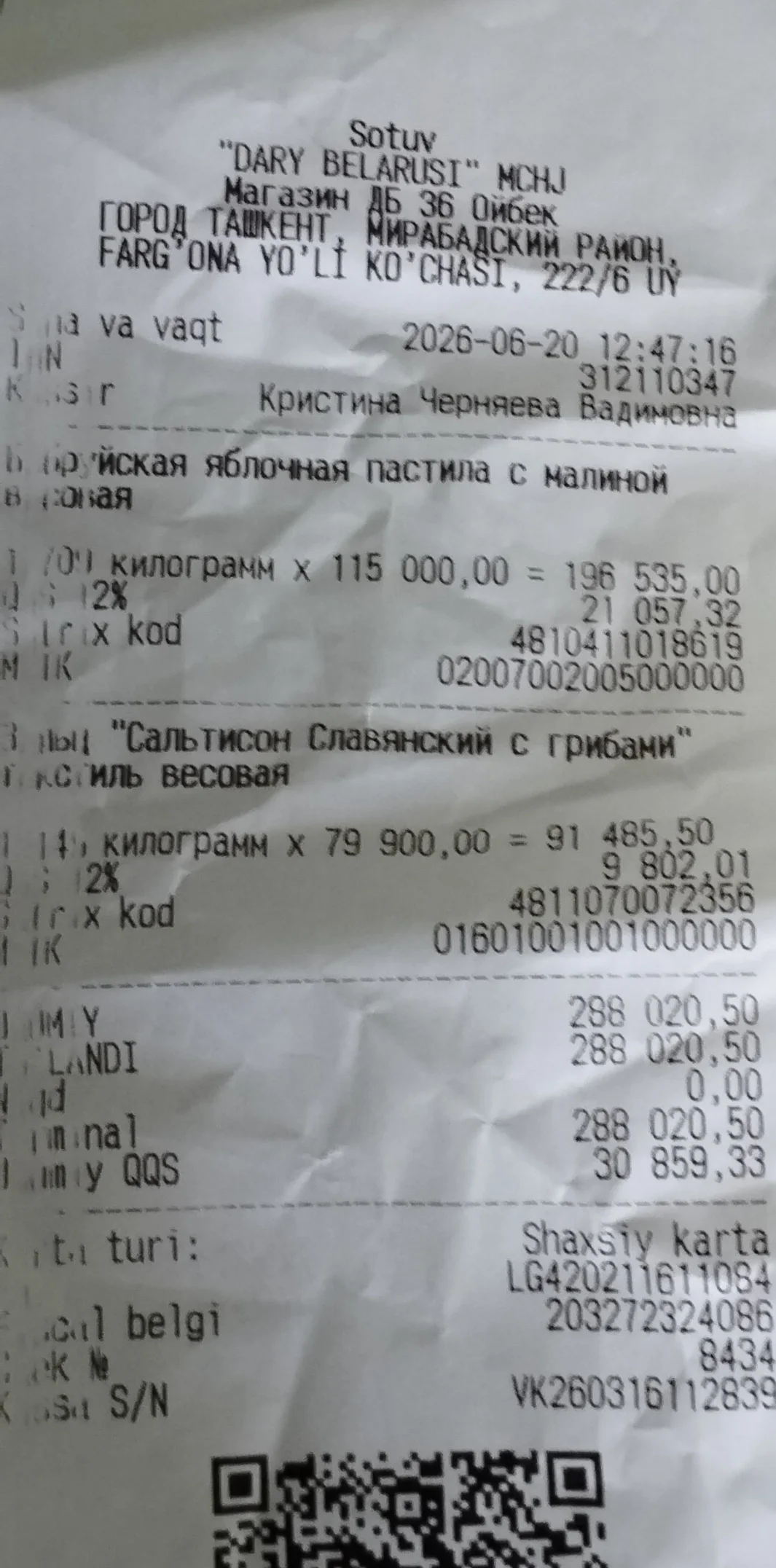
After examining the product closely, I found no obvious signs of raspberry and decided to find out what had happened.
Finding the company’s phone number was not easy. However, many years of experience in journalism helped solve that problem. I contacted the head office and explained the discrepancy between the shelf price and the receipt.
The office promised to investigate. And to their credit, they did.
First, I received a call from the store informing me that they remembered me and that a mistake had been made. Then came another call. I was asked for my bank card number, and shortly afterward the price difference — 43,689 soums — was refunded.
From a formal standpoint, the issue was resolved.
But this is where the main question arises.
What should a customer do next time? What if a product again has no price label? What if it is again charged at a higher price than the one displayed? Should customers have to track down the head office phone number, call, explain the situation and seek a refund every time?
The issue ended well for me only because I decided to spend the time investigating it. Many customers will not.
At the head office, I was told that the absence of price labels on some products was, quoting them directly, the sales staff’s “screw-up.”
Perhaps that is true. But customers are generally less concerned with who is responsible — a salesperson, a store administrator or a manager. What matters to customers is that the price is clear before purchase and matches the amount charged on the receipt.
The problem of missing price labels is not unique to this chain.
There are small shops at Mirabad Market selling similar products. One of them has no price labels at all. When I asked about prices, they turned out to be about 50 percent higher than those at Dary Belarusi. When I asked why, I was told that the shop had no connection to the chain.
That may well be true. But the absence of price labels inevitably creates a sense of opacity. It raises a question: does the price depend on the product, or on who happens to be standing in front of the seller?
There is another example — the Promeat shop at the same Mirabad Market. Some products have price labels, while others do not. As a result, customers cannot easily verify whether the product, the shelf label and the receipt actually match. After several visits, I personally chose not to shop there anymore. The same applies to other similar stores.
This is why the refund story at Dary Belarusi leaves mixed feelings.
On the one hand, the company responded to the complaint, acknowledged the mistake and refunded the difference. Some retail outlets do not even do that.
On the other hand, the problem should not have occurred in the first place.
When customers see a price label, they should be confident that this is the price they will pay at the checkout. When there is no price label, customers should be able to easily find out the price before making a purchase. This is a basic retail standard, not an additional service.
It is particularly surprising to see such issues at a company that is actively expanding its chain of stores.
According to publicly available information, Dary Belarusi LLC was registered in Tashkent on 5 May 2025. The company’s charter capital amounts to 6.114 billion soums. It is classified as a small business entity. The sole founder is Oleg Artyomovich Li, while the director is Yevgeny Yuryevich Odesskikh.
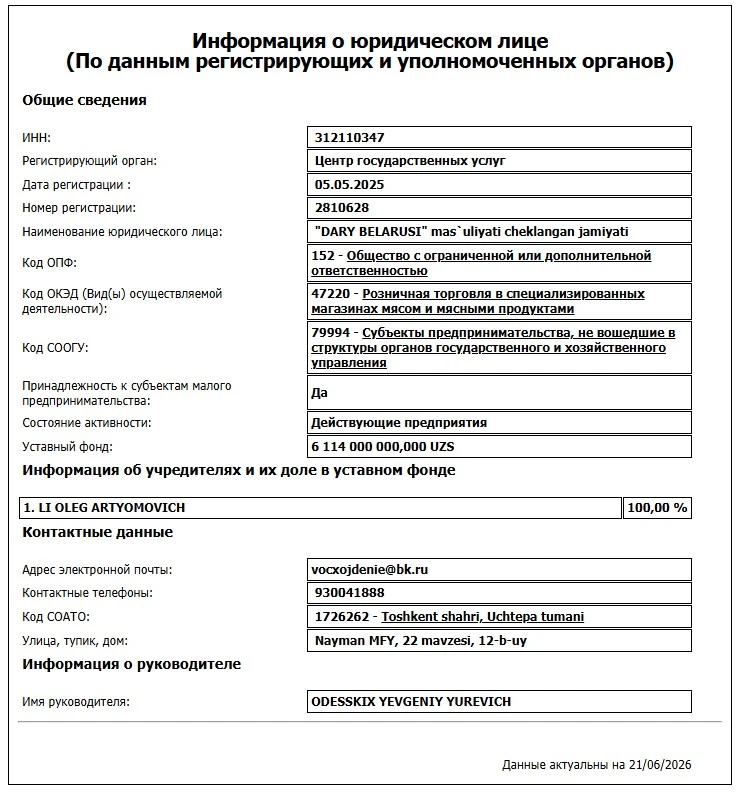
Oleg Li is also the founder of the private enterprise CZK TECHNOPOLIS. Yevgeny Odesskikh is the director and sole founder of XLEB TRADITION LLC, and also heads VOSXOJDENIE LLC, whose founder is the Tashkent and Uzbekistan Diocese of the Russian Orthodox Church.
During one of my visits to Dary Belarusi, I witnessed a telling episode. A woman entered the store, noticed the absence of price labels, asked about them, and demonstratively left without making a purchase. Whether the issue of missing price labels will be resolved following my complaint remains to be seen.
But the refund story prompted me to think about a broader issue. In recent years, customers have become accustomed to loyalty programs, mobile apps, promotions and bonuses. Yet trust in a store does not begin with a loyalty card or attractive advertising.
It begins with a simple question: does the price on the shelf match the price on the receipt, and is there even a price displayed on the shelf at all?
As long as customers have to verify the answer to that question themselves, the aftertaste remains.