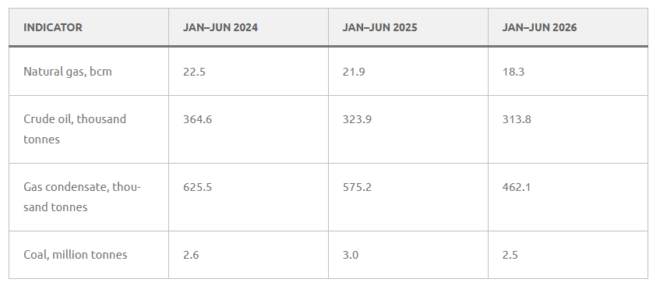
Despite overall growth in industrial production in Uzbekistan, the fuel and energy sector continues to show worrying trends. Statistics for the first half of 2026 indicate that the increase in overall industrial output is taking place against a backdrop of continued declines in the production of natural gas, crude oil, gas condensate, and coal.
Overall industrial growth masks problems in the extractive sector
According to data from the National Statistics Committee, industrial output in Uzbekistan reached 637.2 trillion soums in January–June 2026, up 8 percent from the same period last year. At the same time, the extractive industry remains one of the weakest segments of the economy, with its production volume index reaching only 102.1 percent, significantly lagging behind manufacturing and energy production.
Natural gas production has fallen by nearly one-fifth in two years
The most significant decline was recorded in the gas sector. During the first six months of 2026, Uzbekistan produced 18.3 billion cubic meters of natural gas. A year earlier, the figure stood at 21.9 billion cubic meters, while in January–June 2024 it reached 22.5 billion cubic meters.
As a result, natural gas production has declined by 4.2 billion cubic meters, or nearly 19 percent, over two years. Compared with the first half of 2025 alone, the decrease amounted to about 16.4 percent. Gas remains the country’s key energy resource, making this trend important not only for industry but also for electricity generation, utilities, and export potential.
Oil and gas condensate continue to lose ground
The situation in oil production is similarly revealing. Between January and June 2026, Uzbekistan produced 313,800 tonnes of crude oil, compared with 323,900 tonnes a year earlier and 364,600 tonnes in the first half of 2024.
Compared with January–June 2024, oil production declined by approximately 14 percent. Even compared with last year, output continued to fall, decreasing by around 3 percent. This suggests that the trend is not temporary but persistent.
An even steeper decline can be seen in gas condensate production. Output fell from 625,500 tonnes in January–June 2024 to 575,200 tonnes in 2025 and further to 462,100 tonnes this year.
Over two years, production has fallen by more than a quarter, making it one of the sharpest declines among the country’s major energy commodities.
Coal production declines again after last year’s increase
After growing in previous years, coal production has also begun to fall. Uzbekistan produced 2.5 million tonnes of coal in the first half of 2026, compared with 3 million tonnes during the same period in 2025. This represents a year-on-year decline of about 16.7 percent.
Moreover, the current figure is lower than the 2.6 million tonnes recorded in the first half of 2024.
Gasoline output recovers while diesel production continues to grow
Against the backdrop of declining raw material production, refining presents a mixed picture. Motor gasoline production partially recovered after falling in 2025. Between January and June 2026, Uzbekistan produced 614,200 tonnes of gasoline, compared with 579,700 tonnes a year earlier.
However, despite the increase, production remains below the level of the first half of 2024, when output reached 675,900 tonnes. This indicates that the sector has not yet returned to volumes seen two years ago.
A different trend can be observed in diesel fuel production, which has increased for the second consecutive year. Output rose from 505,100 tonnes in January–June 2024 to 556,400 tonnes in 2025 and reached 568,000 tonnes this year.
The increase in diesel production has occurred despite declining oil extraction, which may suggest a redistribution of feedstock flows and changes in the structure of oil refining. However, the statistical report does not provide an explanation for this trend.
Small producers drive growth in electricity generation
Electricity generation remains one of the few segments of Uzbekistan’s energy sector showing steady growth. The country generated 44.1 billion kWh of electricity in January–June 2026, an increase of 5.7 percent compared with the same period last year.
A closer look at the figures reveals an important detail. Most of the growth came from small electricity producers. According to official statistics, large enterprises generated 29.8 billion kWh, down from 31.3 billion kWh a year earlier. Meanwhile, output by small businesses increased from 10.5 billion kWh to 14.3 billion kWh.
In effect, smaller generating facilities outside the traditional large-scale energy sector accounted for the country’s overall increase in electricity production.
A contradictory picture
Overall, the data for the first half of 2026 present a contradictory picture. On the one hand, Uzbekistan’s industrial sector continues to expand and electricity generation has reached new highs. On the other hand, production of key energy commodities continues to decline. The most notable decreases have been recorded in natural gas, crude oil, and gas condensate.
For now, the statistics merely document these changes without explaining their causes. Nevertheless, the figures suggest that the country’s energy balance is becoming increasingly dependent not on growing hydrocarbon extraction but on expanding generating capacity and the development of smaller electricity producers.
Trial of former Uzbekneftegaz chief takes place against the backdrop of sector challenges
Additional context is provided by recent developments in the oil and gas sector itself. In July, a trial began in Tashkent involving former Uzbekneftegaz Chairman Bahodirjon Sidikov and eight other defendants. According to court records, all defendants face charges of embezzlement through misappropriation or misuse of entrusted property, while some are also accused of abuse of office and official forgery.
The proceedings are taking place against a backdrop of continued declines in natural gas, crude oil, and gas condensate production, which remain the foundation of Uzbekistan’s energy balance. Although the statistics do not link production performance to the criminal case, both developments reflect broader processes taking place within the sector.
Management changes and criticism of energy governance
At the end of July, President Shavkat Mirziyoyev sharply criticized the management of the energy sector. He stated that tens of billions of dollars had been invested in the industry in recent years, yet problems related to management efficiency, energy losses, and infrastructure reliability persist.
Following a special government meeting, Energy Minister Jurabek Mirzamakhmudov was dismissed. The leadership of the country’s largest electricity distribution company was also replaced, while the heads of several major energy enterprises were placed on probation until the end of the year.
Searching for new reserves and investing in modern technologies
At the same time, the authorities are focusing on modernization of the oil and gas industry. Uzbekneftegaz has announced plans to expand geological exploration, introduce artificial intelligence technologies, and increase the scope of three-dimensional seismic surveys.
Particular attention is being paid to the search for new hydrocarbon reserves as production from existing resources continues to decline.
As a result, the first half of 2026 has become a period of conflicting trends for Uzbekistan’s fuel and energy sector: growth in electricity generation and overall industrial output on one hand, and declining production of key energy resources, major management reshuffles, and one of the most significant criminal cases in the history of the country’s oil and gas industry on the other.
Also read:
- Rising demand for aviation fuel and new exploration technologies: what was discussed at the presidential meeting
- Mirziyoyev criticizes energy sector management, dismisses minister and warns industry executives
- Trial begins in Tashkent in case of former Uzbekneftegaz chief: what charges are listed in the court record