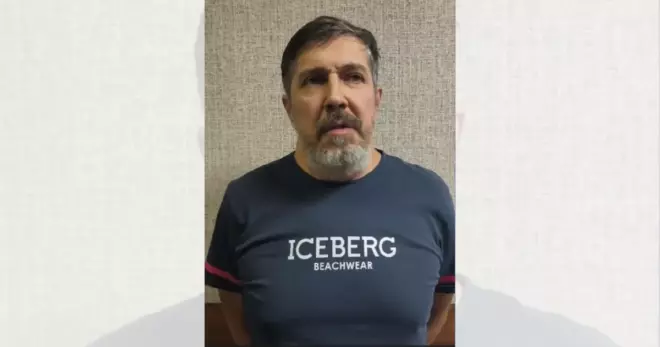
Uzbekistan’s law enforcement authorities have announced the detention and extradition from Egypt of one of the most well-known figures associated with the criminal underworld of the former Soviet Union — Georgy Sorokin, known by the nicknames Zhora Tashkentsky and Soroka. According to the Ministry of Internal Affairs, the man, who had been on an international wanted list, was detained in the Egyptian resort city of Sharm El-Sheikh and brought to Uzbekistan to face criminal charges.
The information was released in a video published by the Ministry of Internal Affairs of Uzbekistan, which includes footage of the detainee and presents the official account of his background and the crimes attributed to him.
Detention in Egypt
In the published footage, law enforcement officers ask Sorokin several questions.
When asked about his origins, he says that he was born in Uzbekistan. Asked about his citizenship, he states that he is a citizen of the Russian Federation and is registered in Moscow. Sorokin also says that he has lived in Dubai in recent years.
When questioned about contacts with criminal figures, he denies maintaining such relationships, claiming that he has not had any such ties for more than ten years.
According to the Ministry of Internal Affairs of Uzbekistan, the arrest resulted from cooperation between Uzbek law enforcement agencies and foreign partners through Interpol channels.
Biography according to investigators
According to information presented in the video, Georgy Nikolayevich Sorokin was born in Tashkent in 1972. Law enforcement authorities describe him as an “especially dangerous repeat offender” and claim that he committed his first crime in 1990 at the age of 18.
According to the authorities, he was sentenced to seven years in prison. They further state that Sorokin was repeatedly prosecuted and served sentences for crimes committed in Uzbekistan, Russia, Kazakhstan, and other countries.
The Ministry says that over the years he was convicted of robbery, extortion, unlawful possession of weapons, and drug-related offenses.
Authorities also claim that a forged Russian passport was found in his possession at the time of his detention. The video shows a passport issued in the name of Evgenii Sergeyevich Alferev, born in 1968 in the Lipetsk region of the former Soviet Union. Law enforcement officials allege that the document had been used for travel between various countries for many years.
Charges in the Tashkent case
The primary reason for placing Sorokin on a wanted list was a criminal case opened in Uzbekistan.
According to investigators, in 2021 Zhora Tashkentsky conspired with several individuals, including Dzhumayev and Dzhurayev, and unlawfully took possession of two residential properties in Tashkent with a combined value of approximately $350,000.
Law enforcement authorities allege that the owner of the properties was subjected to threats and physical violence. Investigators also claim that members of the owner’s family were assaulted. As a result, the properties were allegedly transferred to individuals associated with the suspects.
In connection with this case, criminal proceedings were initiated against Sorokin under Article 165, Part 3(a) of Uzbekistan’s Criminal Code. The charge concerns extortion involving particularly large amounts. The offense carries a potential prison sentence of between ten and fifteen years.
It was after the opening of this case that Sorokin was placed on an international wanted list.
From Tashkent to Moscow
Most open sources agree that Georgy Sorokin was born on May 5, 1972, in Tashkent.
According to various criminological and journalistic publications, he attended Secondary School No. 171 in Tashkent and moved to Russia after being released from prison.
The website Centrasia previously reported that Sorokin held a Russian passport and was registered at an address on Veshnyakovskaya Street in Moscow. Officially, he was listed as a workshop manager at a Moscow company.
According to these reports, he was released under an amnesty in the mid-1990s following his first conviction in Uzbekistan and subsequently became active in Russia.
Becoming a “vor v zakone”
According to open sources, Sorokin obtained the status of a so-called “vor v zakone” — literally “thief-in-law,” a title considered one of the highest informal ranks within the criminal hierarchy of the former Soviet Union — in the late 1990s.
There are differing accounts regarding the circumstances of his elevation. One version claims that the recommendation came from the well-known Uzbek criminal authority Yuldash Ashurov. Another version suggests that Aslan Usoyan, better known as Ded Khasan, one of the most influential criminal figures in the post-Soviet world, played a role.
Zhora Tashkentsky subsequently began appearing regularly in law enforcement reports in Russia and Kazakhstan.
Arrests and convictions in Russia
Open sources report several arrests of Sorokin in Russia.
In February 2001, he was detained in Moscow during a gathering that authorities considered a meeting of criminal bosses.
In 2003, his name appeared in a case involving the robbery of a truck driver and the theft of a truck carrying food products. However, the accusations did not result in a lengthy prison term.
In August 2004, the Noginsk City Court in the Moscow Region found him guilty in another case and sentenced him to three and a half years in prison. He was later released on parole.
In May 2005, Sorokin again came under investigation for illegal possession of weapons. After being released under travel restrictions, he left Russia, leading to his placement first on a federal wanted list and later on an international one.
The Shymkent gathering
One of the most notable episodes in Sorokin’s biography was his detention in Kazakhstan in the summer of 2005.
According to Kazakh media reports, a meeting of criminal figures was being held in Shymkent to resolve a dispute between rival criminal groups.
More than ten individuals described by authorities as criminal bosses were detained during the operation.
Investigators said that weapons and narcotics were found in Sorokin’s possession. He was later convicted by a Kazakh court of illegal weapons possession.
At the time, Kazakh media reported attempts to secure his release and highlighted the public attention surrounding the arrest of a man regarded as one of the most influential criminal figures in the CIS.
Return to Russia and another sentence
After serving his sentence in Kazakhstan, Sorokin returned to Russia.
In the spring of 2009, he was detained once again. In July of that year, Moscow’s Perovsky District Court found him guilty of illegal weapons possession and sentenced him to three years and nine months in prison.
He served the sentence in a correctional colony in Russia’s Smolensk Region.
According to open sources, Sorokin was released in the summer of 2011 after completing his sentence.
Reputation in the criminal world
For many years, Zhora Tashkentsky’s name appeared regularly in publications dealing with organized crime across the former Soviet Union.
A number of Russian and Kazakh media reports, citing law enforcement operational data, claimed that he wielded significant influence within criminal circles in Russia, Kazakhstan, and Uzbekistan.
Some publications described him as one of the most influential “vor v zakone” figures in the CIS. Certain sources even referred to him as the fifth most influential figure in the region’s informal criminal hierarchy. Such assessments, however, are unofficial and are based on media reports and operational information rather than any formal ranking system.
According to a publication by the citizen journalism agency Titus, a Moscow organized crime police briefing described Sorokin as a figure connected to organized crime, weapons and narcotics trafficking, and extensive criminal networks.
What happens next
Following his transfer to Uzbekistan, Georgy Sorokin is now in the custody of Uzbek law enforcement authorities. Officially, he is expected to answer charges related primarily to the extortion and property seizure case in Tashkent.
At present, it remains unclear whether investigators will examine his possible involvement in other crimes or limit their inquiry to the case that has already been opened.
The detention of Zhora Tashkentsky has become one of the most high-profile cases in recent years involving the search for and extradition of figures regarded as influential members of the post-Soviet criminal underworld. After many years living outside Uzbekistan and remaining on an international wanted list, the Tashkent native has once again found himself in the country where, according to law enforcement authorities, his criminal history began more than three decades ago.
Add Yep.uz to your preferred Google sources
Add Yep.uz to your preferred sources in Google to see the site's articles more often in Top Stories.
