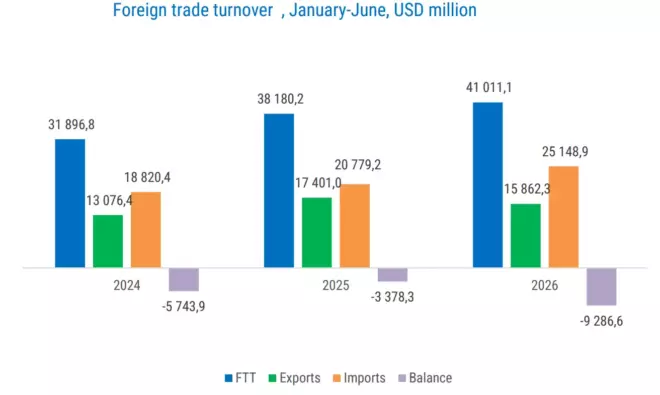
Uzbekistan’s foreign trade turnover reached $41 billion in the first half of 2026, up 7.4% year-on-year. Imports rose by 21% to $25.1 billion, while exports fell to $15.9 billion, causing the trade deficit to widen to $9.3 billion.
China remains Uzbekistan’s largest trading partner and its main source of imports, accounting for about 32% of all imports. Russia retained its position as the largest market for Uzbek exports.
The decline in overall exports was primarily driven by a sharp reduction in gold exports. Excluding gold, merchandise exports grew by 28.7%, while exports of services increased by 35.7% to $6.2 billion.
Uzbekistan’s foreign trade continues to expand, but the growth in trade turnover masks more complex underlying trends. In January–June 2026, the country recorded a new all-time high in foreign trade volume while simultaneously facing a significant widening of its trade deficit and growing dependence on imports of machinery, equipment and consumer goods.
According to data from the National Statistics Committee, Uzbekistan’s foreign trade turnover reached $41 billion in the first six months of the year, up 7.4% compared with the same period of 2025. Exports declined to $15.9 billion, while imports increased to $25.1 billion. The trade deficit reached $9.3 billion.
China and Russia remain the leading partners
The geography of Uzbekistan’s foreign trade continues to be shaped by its two largest partners — China and Russia.
Trade turnover with China reached $9.47 billion, accounting for 23.1% of the country’s total foreign trade. Russia remained in second place with $7.01 billion and a 17.1% share. Together, the two countries accounted for more than 40% of Uzbekistan’s total foreign trade turnover.
Kazakhstan ranked third with trade turnover of $2.78 billion, followed by Turkey, Afghanistan, South Korea, France and the United Arab Emirates. Particularly notable was the growth in trade with Afghanistan, which exceeded $1 billion and moved the country into the top five trading partners of Uzbekistan.
Among the fastest-growing trade partners were Hong Kong, where trade turnover increased more than twelvefold compared with 2024, as well as the UAE and Vietnam.
Growth masks a widening imbalance
Despite the overall increase in trade turnover, the structure of foreign trade reveals a growing imbalance between exports and imports.
In the first half of 2025, the trade deficit stood at $3.4 billion. A year later it had nearly tripled to $9.3 billion. The main reason was a sharp increase in imports coupled with declining export revenues.
A significant part of the decline in overall exports was caused by lower gold sales. Exports of non-monetary gold fell from $6.49 billion to $1.5 billion. Excluding gold, however, the picture looks different: merchandise exports increased by 28.7% to $8.2 billion.
This suggests that non-gold exports continue to expand, although not yet on a scale sufficient to offset the rapid growth of imports.
Exports are becoming more diversified
The export structure shows a gradual move away from a commodity-based model.
Services became the largest export category, accounting for 39.1% of all export revenues. Exports of services rose by 35.7% year-on-year to $6.2 billion. Tourism, transportation, telecommunications and information services were the main drivers of growth.
Among merchandise categories, the strongest results were recorded by:
- industrial goods — $2.4 billion;
- chemical products — $1.28 billion;
- miscellaneous manufactured goods — $1.36 billion;
- food products — $1.32 billion;
- machinery and transport equipment — $633 million.
Textiles remain one of Uzbekistan’s key export sectors. Textile exports reached $1.6 billion during the first six months of the year, up 24.1% from a year earlier. More than half of exports consisted of finished textile products, while the share of raw materials and semi-finished goods continued to decline.
Fruit and vegetable exports also remained significant. Uzbekistan exported $872.9 million worth of fruit and vegetable products during the period. Although growth in this sector was slower than in manufacturing, it continues to play an important role in regional economies and employment.
Who buys Uzbek goods
Russia remains the largest market for Uzbek exports, accounting for nearly 15% of the country’s total exports.
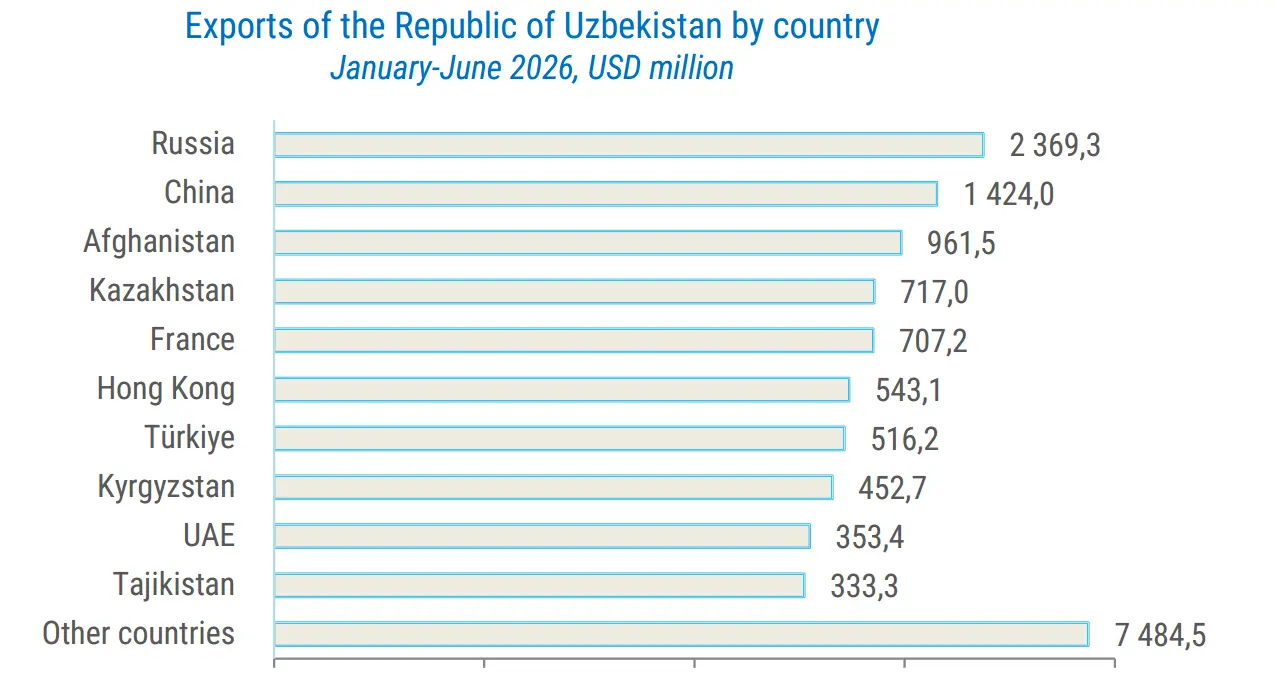
China ranks second, followed by Afghanistan, Kazakhstan, France, Hong Kong, Turkey, Kyrgyzstan and the UAE. Together, these destinations account for more than half of Uzbekistan’s exports.
France and Hong Kong have emerged among the country’s largest export destinations, while Afghanistan remains a major market for Uzbek food products, electricity, petroleum products and industrial goods, including construction materials. However, the statistics committee’s release does not provide a country-by-country commodity breakdown.
Imports are growing faster than the economy
The most striking feature of the first half of the year was the rapid growth of imports.
Import volumes reached $25.1 billion, up 21% compared with the same period of 2025. Imports of goods alone increased by $4 billion to $22.2 billion.
During the same period, Uzbekistan’s GDP grew by only 8.5%. In other words, import growth outpaced overall economic growth by roughly 2.5 times.
Machinery and transport equipment remained the largest import category, reaching $8.25 billion, or nearly one-third of total imports.
This reflects continued investment in industry, construction, energy and infrastructure projects. A significant share of imported equipment is being used to modernize production facilities and implement large-scale government programs.
Food imports also increased, reaching $2.82 billion. Imports of grain, meat, sugar, vegetables and fruit showed particularly strong growth.
Dependence on imported fuel and gas also remained high. This category accounted for more than $2.2 billion, with especially rapid growth in imports of gasoline and liquefied gas.
Cars are becoming one of the largest import categories
One of the most notable trends remains the automotive market.
Imports of vehicles and related products reached $2 billion, up 31.7% year-on-year. Imports of passenger vehicles surged by 84.5% to $778.3 million.
By comparison, exports of vehicles and automotive components amounted to just $130.4 million and were lower than a year earlier.
These figures indicate that domestic demand for vehicles continues to grow much faster than the sector’s export capacity.
China strengthens its position as the main supplier
Import data reveal another important trend — the continued strengthening of China’s role.
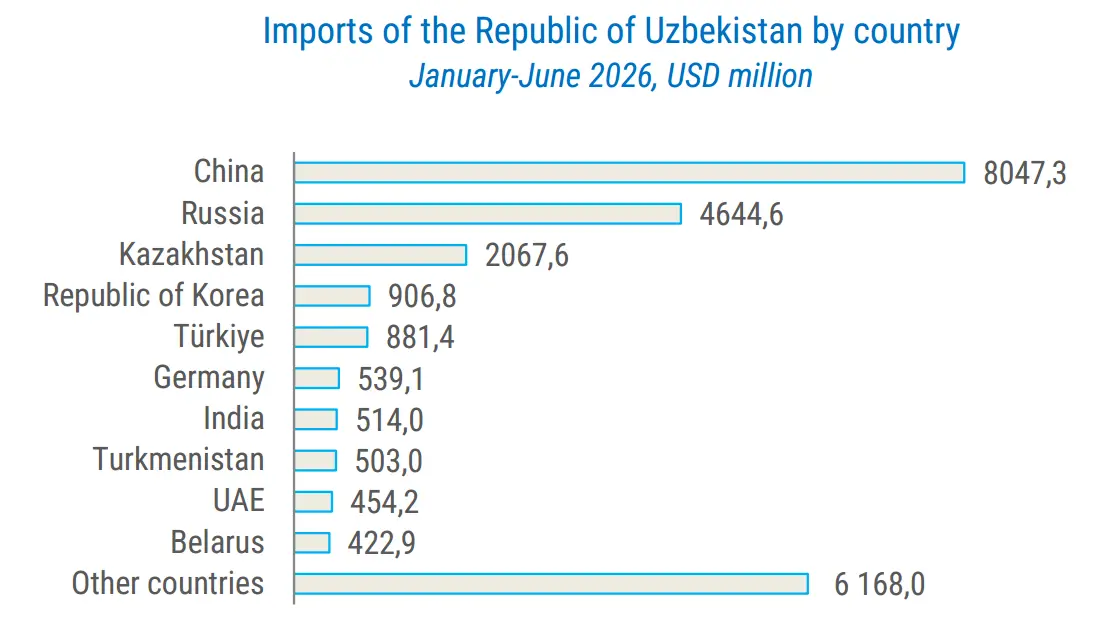
Uzbekistan imported more than $8 billion worth of goods and services from China, equivalent to 32% of all imports. By comparison, Russia accounted for 18.5% and Kazakhstan for 8.2%.
In effect, every third dollar spent by Uzbekistan on imports goes toward Chinese products.
What the first-half results show
The first-half statistics for 2026 present a mixed picture.
On the one hand, Uzbekistan’s economy continues to integrate into global trade. Exports of services are growing, manufacturing is expanding, and exports of textiles, chemicals and manufactured goods are increasing. Exports excluding gold continue to show strong growth.
On the other hand, imports are rising much faster. The country remains dependent on imports of machinery, equipment, fuel and a range of food products, while the trade deficit has reached record levels.
For Uzbekistan, this means that future economic growth will increasingly depend not only on the volume of trade but also on its ability to expand exports with higher value added and narrow the gap between imports and exports.
Also read: