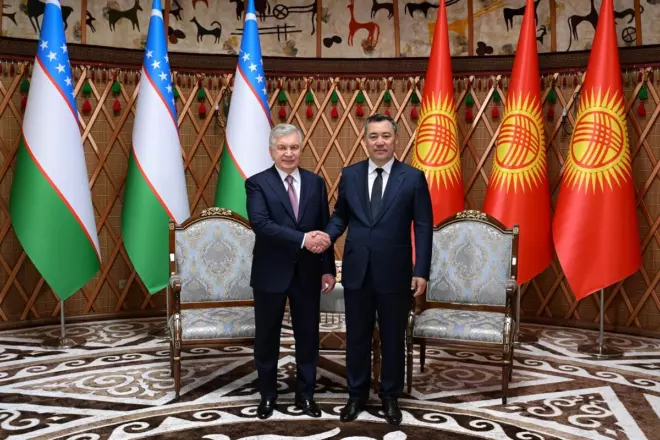
Uzbekistan and Kyrgyzstan signed a Treaty on Allied Relations following talks between President Shavkat Mirziyoyev and President Sadyr Japarov held on July 30 in Cholpon-Ata on the shores of Lake Issyk-Kul.
The talks took place at the Rukh Ordo cultural center.
The package of signed documents also included an agreement on the joint use of the Chashma spring, which for many years remained a source of disputes between residents of border communities in the two countries and was linked to one of the most serious cross-border conflicts in recent years.
The two sides also signed documents related to the state border, border crossing points and economic cooperation.
The package additionally included a cooperation agreement between the defense ministries of Uzbekistan and Kyrgyzstan. No details of the document were disclosed.
The leaders announced the creation of an Interstate Council that will coordinate bilateral cooperation at the highest level. During the meeting, they discussed expanding trade and economic ties, the construction of the China–Kyrgyzstan–Uzbekistan railway and the Kambarata-1 hydropower project.
During the visit, Japarov also awarded Mirziyoyev the Order of Manas, First Class, one of Kyrgyzstan’s highest state honors.
From border disputes to alliance
The signing of the Treaty on Allied Relations marks another step in the rapprochement between the two countries, whose relations until a few years ago were complicated by unresolved border issues. According to Mirziyoyev, the focus should now shift to giving practical substance to the new alliance.
“Our main task now is to fill this cooperation with new content, projects and initiatives that will serve the progress and well-being of our countries and peoples,” the Uzbek president said.
Following the collapse of the Soviet Union, several sections of the Uzbek-Kyrgyz border remained under negotiation for decades. Disputed areas frequently became a source of tension between residents of border districts.
After 2016, Tashkent and Bishkek intensified negotiations on border issues. In January 2023, the presidents of the two countries announced the completion of the delimitation of the state border.
Work on the final demarcation of the border continued afterward. In June 2026, it was announced that, as part of the demarcation process, the villages of Chongara and Tash-Tobo, previously part of Uzbekistan’s Fergana Region, were transferred to Kyrgyzstan. In exchange, Kyrgyzstan transferred land plots of equal size to Uzbekistan in the border area. The two sides also exchanged territory to facilitate the construction of a road linking the settlements of Sai and Tayan in Kyrgyzstan’s Batken Region.
During the current visit, another document concerning sections of the state border was signed. The Kyrgyz side said the new agreements would finally settle the remaining border issues.
According to Japarov, the number of border crossing points between the two countries will double after the implementation of the new agreements. The sides also agreed to extend the period of mutual stay for citizens to 15 days and discussed opening a Kyrgyz consulate in Andijan.
“We have completely resolved all border issues, increased the number of border crossing points from 15 to 30, extended the period of stay for citizens of our two countries to 15 days, and supported the establishment of a Consulate General of the Kyrgyz Republic in the city of Andijan,” Japarov said.
A spring that became a source of dispute
Among the signed documents, particular attention has been drawn to the agreement on the joint use of the Chashma spring, known in Kyrgyzstan as Chechme.
The spring is located near the Uzbek exclave of Sokh, which is surrounded by Kyrgyz territory. Because of its importance to local communities, it has long been a source of disputes between residents of border areas in both countries.
The most serious incident occurred on May 31, 2020.
Clashes broke out around the spring between residents of Sokh District in Uzbekistan’s Fergana Region and Kadamjay District in Kyrgyzstan’s Batken Region.
According to reports from both sides, the dispute began over work to clean the spring and nearby irrigation channels. The confrontation quickly escalated into mass clashes. Uzbekistan reported at least 187 injured people, while Kyrgyzstan reported 25 injured.
The situation required intervention from the leadership of both countries. The prime ministers of Uzbekistan and Kyrgyzstan traveled to the area, while Presidents Shavkat Mirziyoyev and Sooronbay Jeenbekov held a phone conversation focused on resolving the crisis.
In the following years, the Chashma issue became part of broader negotiations on the border and water resources.
In April 2025, the two countries agreed on a border arrangement under which the spring remained on Kyrgyz territory while Uzbekistan received rights to use two-thirds of its water, with citizens of both countries retaining free access. Under the agreement, any actions that could affect the volume or quality of the water must be coordinated between the two sides.
The agreement signed in Cholpon-Ata represents the latest step in resolving a long-running dispute that had remained a source of tension along the Uzbek-Kyrgyz border for many years.
Economy and infrastructure
Beyond border issues, the leaders devoted considerable attention to economic cooperation.
According to the Uzbek side, bilateral trade reached $1.2 billion last year. Tashkent and Bishkek said they intend to increase that figure to $2 billion.
Large infrastructure projects also featured prominently in the talks. The two countries reaffirmed their commitment to the China–Kyrgyzstan–Uzbekistan railway, which is expected to create a new transport route linking China with Central Asia.
The construction of the Kambarata-1 hydropower plant, one of the region’s largest energy projects, was also discussed.
The alliance treaty, agreements on border and water issues, and discussions on joint infrastructure projects reflect a significant transformation in relations between the two countries compared with a period when attention was largely focused on resolving territorial disputes.
List of signed documents
The press services of the two presidents published lists of signed documents that do not fully coincide. Both versions are provided below.
According to the press service of the President of Uzbekistan:
- Treaty on Allied Relations;
- Treaty on sections of the Uzbek-Kyrgyz state border;
- Agreement on the joint use of the Chashma spring;
- Agreement on state social insurance and pension provision;
- Agreement on mutual recognition of credits in higher education;
- Protocol on introducing amendments and additions to the intergovernmental Agreement on checkpoints across the state border;
- Protocol to the intergovernmental Agreement on mutual travel of citizens;
- Protocol to the Agreement on resort and recreational facilities located in the Issyk-Kul region of the Kyrgyz Republic;
- Action Plan in the cultural sphere for 2026–2027
- Joint Action Plan in the tourism sector for 2026–2027;
- Treaty on the “Buston” boarding house in the Ton district of the Issyk-Kul region of the Kyrgyz Republic;
- Plan of practical measures in the agro-industrial complex for 2026–2027.
According to the press service of the President of Kyrgyzstan:
- Treaty on Allied Relations between the Kyrgyz Republic and the Republic of Uzbekistan;
- Treaty between the Kyrgyz Republic and the Republic of Uzbekistan on a section of the Uzbek-Kyrgyz state border;
- Agreement between the Cabinet of Ministers of the Kyrgyz Republic and the Government of the Republic of Uzbekistan on the joint use of the Chechme (Chashma) spring;
- Protocol on Amendments and Additions to the Agreement between the Government of the Kyrgyz Republic and the Government of the Republic of Uzbekistan on Border Crossing Points across the State Border of July 24, 2004;
- Agreement between the Cabinet of Ministers of the Kyrgyz Republic and the Government of the Republic of Uzbekistan on State Social Insurance and Pension Provision;
- Protocol Amending the Agreement between the Government of the Kyrgyz Republic and the Government of the Republic of Uzbekistan on Mutual Travel of Citizens of October 3, 2006;
- Agreement between the Ministry of Defense of the Kyrgyz Republic and the Ministry of Defense of the Republic of Uzbekistan on Cooperation;
- Protocol Amending the Agreement between the Cabinet of Ministers of the Kyrgyz Republic and the Government of the Republic of Uzbekistan on Resort and Recreational Facilities Located in the Issyk-Kul Region of the Kyrgyz Republic of July 18, 2024;
- Action Plan for Cooperation in the Cultural Sphere for 2026–2027 between the Ministry of Culture, Information and Youth Policy of the Kyrgyz Republic and the Ministry of Culture of the Republic of Uzbekistan;
- Action Plan for Further Deepening Bilateral Cooperation in the Agro-Industrial Sector for 2026–2028 between the Ministry of Water Resources, Agriculture and Processing Industry of the Kyrgyz Republic and the Ministry of Agriculture of the Republic of Uzbekistan;
- Joint Action Plan for Cooperation in Tourism between the State Agency for Tourism Development under the Cabinet of Ministers of the Kyrgyz Republic and the Tourism Committee of the Republic of Uzbekistan;
- Agreement between the Ministry of Science, Higher Education and Innovation of the Kyrgyz Republic and the Ministry of Higher Education, Science and Innovation of the Republic of Uzbekistan on the Mutual Recognition of Higher Education Credits;
- Action Plan for the Development of Bilateral Cooperation for 2026–2028 between the National Investment Agency under the President of the Kyrgyz Republic and the Ministry of Investment, Industry and Trade of the Republic of Uzbekistan.
A comparison of the two lists shows that most key documents overlap and relate to allied relations, the state border, the Chashma spring, border crossing points, travel arrangements for citizens, social protection, education, culture, tourism and agriculture. However, the list published by the Kyrgyz side includes a defense cooperation agreement and an investment cooperation plan that are not mentioned in the list released by the Uzbek side. Conversely, the Uzbek side separately reported an agreement concerning the Buston resort in Issyk-Kul Region, which does not appear in the Kyrgyz list.
Also read:
