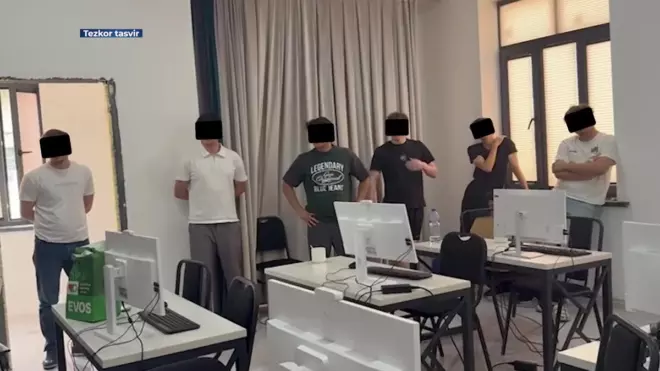
Uzbekistan has uncovered a scheme involving the illegal acquisition of international SAT certificates, the results of which are used for admission to higher education institutions. According to the State Security Service, a group set up a real “bunker” in a private school building in Tashkent’s Yangihayot district: an IT specialist provided covert access to the system, while students remotely completed the tests instead of the actual candidates.
The operation was carried out by officers of the Tashkent Regional Department of the State Security Service together with officers of the regional police department. According to the agency, most of the group’s members were students at the Tashkent branch of a prestigious European university. Another member was studying at the Tashkent branch of one of the leading universities of an Asian country.
The mechanism itself was relatively straightforward. According to the State Security Service, an employee of an IT company illegally gained access to the system and enabled the group to work with the test questions. The students then solved the questions remotely — instead of the people who were supposed to take the exam.
“They organized a ‘bunker’ in a private school building in Yangihayot district.”
This is how the government agency describes the place where the scheme was organized.
$1,500 per certificate
The money involved in the scheme also had a specific price. One member of the group demanded $1,500 from each of five people seeking a certificate. That meant potential payments totaling $7,500 if all five arrangements had been paid in full.
According to the State Security Service, money had already been received from one client through a cryptocurrency wallet.
This was not simply a matter of selling a forged document. According to the agency’s description, the scheme involved interference with the actual testing process: one person provided access to the system, others solved the questions, and the result was supposed to be registered in the name of the actual candidate.
“The students remotely solved the questions instead of the candidates.”
This distinguishes the scheme from ordinary document forgery: the certificate was supposed to appear as the result of a real examination, although the questions were in fact answered by other people.
The State Security Service does not specify how the participants in the “bunker” themselves solved the test questions or whether they used any additional tools.
A criminal case has been opened against the suspects under Article 168 of the Criminal Code, which covers fraud. The investigation is ongoing. The final legal assessment of the participants’ actions will therefore depend on the results of the investigation and court proceedings.
A similar issue arose around IELTS a year ago
The SAT case did not emerge in isolation. In July 2025, Uzbekistan abruptly suspended paper-based IELTS testing. From July 11, the exam could be taken only on computer.
The official explanation at the time was cautious. IDP IELTS said that the IELTS partners — IDP, the British Council, and Cambridge University Press & Assessment — were “suspending IELTS paper-based testing in Uzbekistan for operational reasons.” Candidates who had registered were offered a free transfer to the computer-based test or a refund.
At the same time, Uzbek media reported leaks of test answers. Kun.uz wrote that the decision followed the circulation of answers to the paper-based test online.
Another earlier example — Kazakhstan
In 2019, I wrote on Yep.uz about a much larger IELTS scandal in Kazakhstan. More than 100 students at a medical university were expelled, and criminal cases were opened against them in connection with forged IELTS certificates. According to figures cited in that article, 117 cases had been transferred to court.
The consequences of certificate fraud can therefore extend beyond the examination itself. If a person obtains a high English-language score, gains admission to a foreign university on the strength of that result, and then is unable to study in English, questions can arise about the reliability of the selection process.
SAT (Scholastic Assessment Test) is a standardized international college admissions test that measures reading and writing and mathematics. It is widely used for university admissions in the United States and is also accepted by some institutions in other countries. In Uzbekistan, SAT scores may also be used for admission to certain higher education institutions and for benefits provided under national regulations when the relevant certificate is held.
Read also:
